
Is your sales team actually selling, or have they become high-paid researchers? In most modern B2B organizations, the "hustle" paradox is real. Sales reps spend their mornings tabs-deep in LinkedIn profiles, scouring company websites, and manually updating CRM entries. They are working harder than ever, yet they are fighting against a tide of digital noise that makes traditional prospecting feel like shouting into a void.
The reality of modern commerce is that the old playbook is hitting a wall. Buyers are more informed, inboxes are more crowded, and the "spray and pray" method of outreach is officially dead. To thrive, businesses are moving away from manual "detective work" and toward a truly automated intelligence engine.
This comprehensive guide explores how AI in Sales is redefining the entire revenue funnel. From scaling account research to automating the marketing-to-sales handoff and deploying autonomous prospecting agents, we are entering an era of precision. By leveraging advanced tools, high-growth teams are reclaiming their most valuable asset: time.
What is AI in Sales and Why Is It Necessary Today?

If we strip away the technical jargon, AI in sales is simply the use of machine learning and autonomous agents to eliminate the "guesswork" from the revenue funnel. It acts as a digital nervous system for your team, connecting dots between disparate data points that a human would likely miss. But why has this transition moved from a "nice-to-have" innovation to a survival requirement in the modern B2B landscape?
The answer lies in the fundamental breakdown of the traditional, human-only sales model. Today's buyers are more elusive than ever. They conduct the vast majority of their research in the "dark funnel"—private Slack communities, third-party review sites, and social feeds—long before they ever touch your CRM visibly. This shift has created an invisible drain on productivity that manual efforts can no longer plug.
Consider the sheer volume of "non-selling" activities that bog down a typical representative.
According to a comprehensive Salesforce study, sales representatives spend a staggering 72% of their week on tasks that are not actually selling.
When you break that down, a massive portion is dedicated to manual account research, data entry, and lead filtering. If a rep works a 40-hour week, they are spending less than 12 hours actually talking to prospects.
Furthermore, the "Speed-to-Lead" gap has become a primary revenue killer.
Research consistently confirms that responding to a lead within five minutes makes them 10x more likely to convert.
However, most human-led teams, constrained by meetings, time zones, and sleep, take hours or even days to follow up. By the time a human rep picks up the phone, the prospect has often moved on or found a solution elsewhere.
AI in sales solves this by shifting the focus from manual labor to strategic oversight. We are moving away from basic automation toward autonomous agents—digital teammates that research news, monitor intent signals, and execute outreach 24/7. This ensures your brand is the first to respond, with the right context, every single time.

2. The End of MQLs: Predicting Pipeline with Certainty

Is the "Marketing Qualified Lead" actually a lead, or is it just a metric we use to feel productive? For years, the MQL has been the gold standard of marketing success. We celebrated when a whitepaper download triggered a notification, and we passed that "lead" to sales with a sense of job well done. But if we look at the data, a quieter, more frustrating reality emerges.
This gap between marketing effort and sales results is creating a crisis in the modern funnel.
Did you know that a staggering 84% of businesses struggle to convert MQLs to SQLs?
We are currently witnessing the end of MQLs as a reliable predictor of revenue. In its place, a new era is rising—one defined by AI and autonomous systems that shift the focus from static form-fills to dynamic, predictable pipeline generation.
Why the Traditional MQL is Dying (and Why We Should Let It)
To understand why the MQL is failing, we must examine how the buyer's journey has fundamentally changed. Modern buyers are researchers. They spend a massive amount of time in the "dark social" or "dark funnel" before they ever talk to a salesperson. What are these? These are the steps on a research journey that your CRM cannot track: the massive amount of research a buyer does in Slack communities, private groups, and third-party review sites before they ever "touch" your company visibly.
By the time a prospect fills out a form to become an MQL, they are either already ready to buy or—more likely—just looking for a quick answer.
Gartner research confirms that B2B buyers only spend 17% of their time actually talking to suppliers.
They spend a whole lot more of their journey finding out what other people have to say about vendors.
Furthermore, traditional lead scoring is often too rigid. It relies on demographic factors such as job title or company size. While these are important, they don't capture the "micro-moments" of intent.
Behavioral data is actually 3x more predictive of conversion than static demographic traits.
If a prospect visits your pricing page five times in one hour, that is a much stronger signal than their LinkedIn title.
Beyond the Point System: AI-Powered Lead Scoring
The biggest problem with the old way is the "point system." We gave points for opening an email or attending a webinar, but we were just guessing. AI-powered lead scoring moves us from "if-this-then-that" logic into the world of predictive modeling. Instead of a marketer guessing what a visit is worth, a machine learning model looks at years of your historical "Closed-Won" data. It identifies the exact sequence of events that led to a sale.

AI doesn't just look at one action; it considers the relationships between actions. It recognizes a "Ready-to-Buy" pattern that a human would never see without hours of manual research. This level of insight enables Intent-Based Enrollment. Instead of waiting for a prospect to fill out a "Contact Us" form, an AI agent can flag them as a high-priority target based on their journey through your documentation and case studies.
The Shift to Predictable Revenue Operations
The biggest benefit of moving away from the MQL and toward AI agents is predictability. In the old model, the pipeline was a "best guess" based on funnel volume. In the new model, it becomes a math problem.
-
Growth Certainty: AI-enabled sales teams are 1.4x more likely to increase their headcount because their growth is predictable.
-
Reduced CAC: Because the AI handles qualification in real time, the leads who reach the sales team are actually ready to talk. This leads to a significant reduction in customer acquisition costs (CAC), as less human time is wasted on dead-end leads.
-
Higher Engagement: Companies that prioritize high-intent lead generation achieve engagement rates of up to 45%, compared to the industry average of 12%.
The Marketer as the "Architect of Intent"
This transition also changes the marketer's role. In the old model, marketing was responsible for "feeding the beast"—constantly generating more volume to account for low quality. In the AI-driven model, marketing becomes the Architect of Intent.
Marketers now focus on defining the parameters within which AI agents operate. They craft the core brand voice, refine high-value offers, and analyze data to identify which sales profiles are performing best. This is a much more strategic role that moves marketing from a cost center to a primary driver of revenue predictability. By using AI to be more precise, we actually make the sales process more human and less annoying for the buyer. We are no longer "blasting" a message; we are "serving" a solution exactly when it is needed.
The math is clear, and the technology is ready. The only question left is how quickly you can adapt. Transitioning to a post-MQL world requires a shift in mindset, but the reward is a predictable, sustainable revenue engine that respects both your team's time and your customer's journey.

3. Deploying the HubSpot Breeze Prospecting Agent
HubSpot Breeze represents a fundamental shift in how modern revenue teams build pipelines. It isn't a passive chatbot waiting for a user to type a query; it's a proactive, fully autonomous agent integrated directly into the HubSpot Smart CRM ecosystem.
Data from HubSpot reveals a massive paradigm shift: roughly 43% of sales representatives are now actively utilizing artificial intelligence within their daily workflows—marking a staggering 79% surge year-over-year.
The reason for this sudden adoption curve is clear. High-growth teams are realizing that manual top-of-funnel mechanics are a broken luxury they can no longer afford. When your competitors are deploying autonomous intelligence to handle initial engagement, you simply cannot keep pace by asking your human reps to work longer hours.
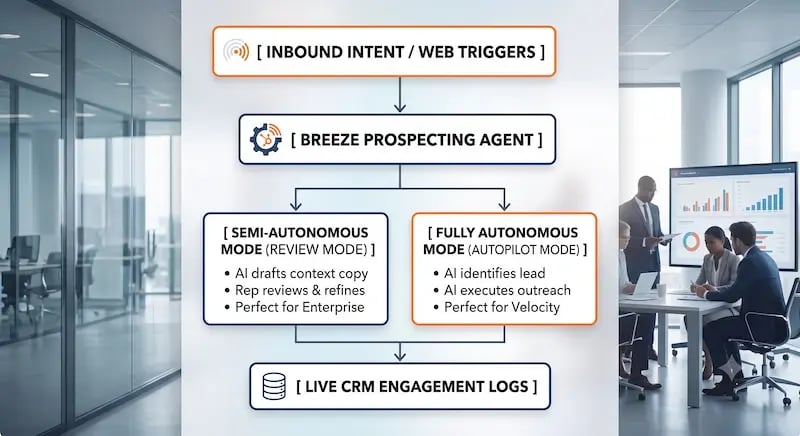
The Breeze Prospecting Agent solves this bottleneck by operating silently in the background, transforming passive contact records into active sales sequences via a continuous execution loop.
The core operational architecture of the agent functions across three primary layers:
-
Autonomous Research: Rather than requiring an SDR to dig through fragmented public records, the agent scans global networks to track real-time firmographic shifts, company news, hiring trends, and technological changes.
-
Personalized Outreach: It completely bypasses generic, template-driven messaging. By cross-referencing your defined Ideal Customer Profile (ICP) and unique buyer personas, the agent drafts hyper-contextualized outreach copy that addresses a prospect's specific operational pain points, using your unique brand voice guidelines.
-
Intent-Based Enrollment: It replaces arbitrary cold calling with behaviorally-driven precision. The agent monitors high-intent actions—such as a prospect visiting your pricing page multiple times in a single afternoon—and uses that signal to trigger immediate enrollment into an outreach sequence.
-
Finding the Hidden Stakeholders: Your Breeze Agent can also dive deep into who the critical decision-makers are and tailor outreach to ensure they receive the information needed to make a decision.
By leveraging this native intelligence, sales organizations can completely dictate their level of strategic control through two distinct operational settings:
1. Semi-Autonomous (The Review Mode)
Perfect for high-ticket enterprise accounts where every word requires strict human oversight. The agent executes the necessary account research and frames the introductory communication, but the human representative retains final approval. This creates a valuable machine-learning loop: as reps refine and edit the drafts, the underlying AI continuously adapts to match their personal communication nuances.
2. Fully Autonomous (The Autopilot Mode)
Ideal for high-velocity transactional tiers or outreach sequences that have already been heavily optimized. The agent independently identifies the correct decision-maker, runs the behavioral evaluation, fires the communication, and updates the CRM. Your human frontline reps only step into the sequence when a prospect actively replies and is ready for a strategic conversation.
This hybrid collaboration changes how we evaluate sales efficiency.
HubSpot's State of AI data confirms that 45% of high-performing teams are successfully leaning on this blended human-agent framework.
By letting machine workflows shoulder the robotic, repetitive burdens of data-gathering, human reps reclaim more than 2 hours every single day. On a mid-sized team of ten professionals, that translates to reclaiming over 100 hours of monthly productivity.
This dramatic reduction in overhead changes the financial math entirely:
Utilizing autonomous agents to qualify intent can reduce a company's average cost-per-meeting from a traditional $420 to roughly $140—a 67% reduction in client-acquisition friction.
4. The ROI of Native Data: Breeze Intelligence vs. Everybody Else
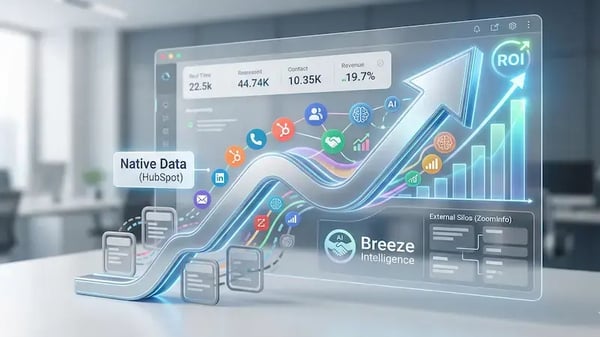
Is your technology stack actively accelerating your growth, or are you quietly paying an expensive "integration tax" to maintain a healthy and productive pipeline? Modern Revenue Operations (RevOps) leaders are increasingly moving away from fragmented, legacy third-party platforms and shifting toward native data enrichment capabilities. For years, the industry standard was to bolt market-leading datasets, such as ZoomInfo, into a CRM to provide contact data. However, as execution speeds compress, the friction of maintaining separate databases has changed the financial math entirely.
The Problem with Fragments
When critical commercial data lives outside your core execution system, the hidden costs accumulate rapidly. API connections break, custom properties fail to map correctly, and sync lags stall momentum.
According to research by ZoomInfo, sales and marketing teams lose roughly 550 hours per representative annually simply dealing with bad data or jumping between disconnected software systems.
If a rep has to verify details in an external database, manually copy-paste firmographic values, and wait for a secondary data provider to refresh, your sales velocity suffers.
The Native Advantage
Breeze Intelligence solves this foundational friction by embedding its rich dataset directly into the HubSpot Smart CRM infrastructure. This completely eliminates the need for expensive middleware or complex synchronization schedules that older data providers require. By unifying data collection and sales execution within a single environment, high-growth organizations unlock two distinct operational advantages:
Smart Form Shortening:
Long forms are notorious friction points that kill digital lead generation.
Landbase data demonstrates that reducing form requirements from 5 fields to just 4 fields can spike conversion rates by a staggering 120%.
With a native intelligence model, a website visitor only needs to provide their business email address; HubSpot instantly matches the record against its internal dataset to automatically backfill company size, industry vertical, and technographic footprints behind the scenes.
Zero-Latency Speed to Lead:
Because the enrichment engine lives natively within the CRM data layer, records are scored, segmented, and routed the millisecond they are captured. There is no 15-minute data sync delay between separate platforms. This zero-latency environment ensures your automated prospecting sequences fire immediately, enabling your brand to secure the under-five-minute response window critical to capturing in-market intent.

5. Security, Trust, and the Ethics of Autonomous Outreach
As commercial teams rapidly transition toward agentic workflows, executive leadership frequently hits a fundamental roadblock: the trust gap.
Industry surveys indicate that a striking 39% of marketers and sales leaders remain highly uncertain about how to deploy generative AI applications without explicitly risking corporate data integrity.
If your system relies on public cloud models that scrape inputs to train external systems, scaling your outreach isn't just an efficiency play—it is a compliance liability.
Building a Private B2B AI Architecture
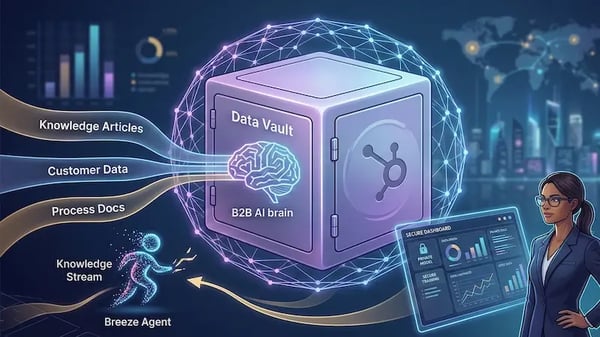
The technical solution requires moving away from reactive, fragmented tools and instead establishing an isolated, private "digital brain." By training your autonomous agents natively within a secure ecosystem—such as grounding your HubSpot Breeze agents directly in your verified internal knowledge base and centralized CRM data—you ensure the model deeply inherits your product's complex nuances without leaking proprietary intellectual property into the public domain.
When your AI is strictly restricted to this single source of truth, the downstream operational metrics shift dramatically:
-
Drastic Accuracy Improvements: Gartner documentation reveals that when generative architectures are tethered to verified, internal company data repositories, AI response accuracy reaches an exceptional 93%.
-
Compounded Search Efficiency: Transitioning to centralized, AI-driven knowledge management removes internal friction from your workflow—reducing the time employees waste hunting for obscure case studies, technical documentation, or pricing parameters by 85%.
-
Enforcing Strict Operational Guardrails
 However, resolving data security is only half the battle; high-growth teams must also safeguard their long-term brand equity. The ethics of autonomous outreach ultimately boil down to respecting your prospect's time, data, and attention. If your automated systems are unmonitored, you aren't building authentic B2B relationships—you are just scaling digital noise.
To prevent autonomous engines from sending misaligned or aggressive communications, RevOps leaders must engineer rigid operational guardrails directly into their CRM workflow logic:
-
The Negative-Targeting "Off-Limits" List: Build definitive blocklists to ensure autonomous prospecting agents never inadvertently contact high-value enterprise target accounts, active customers, sensitive strategic partners, or deals currently navigating late-stage human negotiations.
-
Complexity Escalation Triggers: Human-led oversight remains vital. If an inbound prospect responds to an automated message with a nuanced technical request, a pricing objection, or an emotional hurdle, the AI must immediately pause the automated sequence and seamlessly route the live conversation record to a senior account executive.
-
Transparent Personalization over Deception: High-performing pipelines never attempt to trick a buyer into believing an AI agent is a live human representative. In modern B2B commerce, authenticity is the highest-converting currency.
Data from McKinsey confirms that 71% of consumers explicitly expect highly personalized, transparent interactions.
By building an outbound motion that is AI-powered but firmly human-led, you protect your brand's integrity while respecting the customer's buying journey.
7. The Evolution of the SDR: Engineering the Agent-Driven Sales Organization
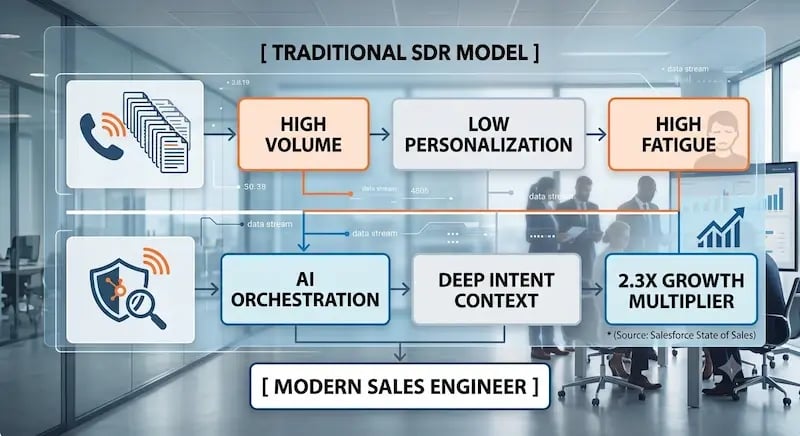
The Sales Development Representative (SDR) of the past was valued for sheer raw output: dialing hundreds of phone numbers a day, blasting unoptimized email templates, and manually scraping contact lists. Today, that manual playbook is hitting an undeniable wall.
The entry-level SDR is rapidly transitioning into a sophisticated "Sales Engineer" or AI Orchestrator. The job is fundamentally moving away from repetitive, low-leverage physical labor and toward high-level strategic orchestration.
According to Salesforce benchmarks, high-growth organizations are 2.3x more likely to actively use AI within their sales processes than stagnant ones.
This divide isn't about replacing the human element; it is about scaling it. The future belongs entirely to commercial teams that use machine learning to eliminate administrative friction, intentionally creating more mental space for authentic human connection.
Successfully integrating autonomous agents into a modern sales organization, however, requires a deliberate, structured framework rather than simply turning on a new software feature. To transition your frontline from dialers to prompters, leadership must drive an intentional upskilling initiative across three core competencies:
-
Prompt Engineering: Reps must learn to communicate with AI models precisely. This means defining explicit parameters, setting structural context, feeding accurate customer personas, and guiding the underlying autonomous engine to produce highly targeted accounts and accurate outreach copy.
-
Strategic Ghostwriting: Because AI excels at drafting context but can occasionally sound sterile or overly generic, the modern SDR acts as a critical brand editor. Their job is to inject authentic empathy, refine the messaging cadence, and ensure that every machine-generated touchpoint aligns perfectly with the brand's unique voice and soul.
-
Predictive Analytical Thinking: Instead of waiting for a static list of names, reps must learn to manage complex, multi-channel data flows and real-time intent signals. They analyze behavior—such as specific product page interactions or localized technographic changes—to actively determine which accounts are ready for a human-led conversation.
-
Implementing this shift across your sales organization requires a pragmatic, phase-based deployment roadmap. Rather than attempting a disruptive, top-down overhaul overnight, successful organizations begin by identifying specific, high-friction bottlenecks within the existing funnel—such as pre-call company research or initial outbound follow-ups. By running isolated pilot tests with a small group of reps using tools like HubSpot Breeze, you can safely establish internal performance baselines, iron out compliance guardrails, and refine your custom prompt repositories.
Once the pilot program proves a measurable reduction in meeting acquisition costs and an acceleration in deal velocity, the framework can be scaled across the entire revenue division. By shifting the metrics of success from raw activity volume to strategic conversion efficiency, you transform your sales department from a reactive outbound center into a highly predictable revenue engine.
8. Building Your Predictable Revenue Engine
The transition from a legacy, human-only prospecting model to an AI-led sales architecture can feel like a daunting operational leap. However, the mathematical reality facing modern commerce is impossible to ignore.
Landmark McKinsey documentation reveals that forward-thinking companies adopting advanced AI sales strategies consistently achieve a 20–30% higher ROI than competitors clinging to outdated, traditional outreach playbooks.
By prioritizing high-intent behavioral data over uneducated guesses and structurally choosing deep quality over raw message volume, you immediately place your sales organization in a definitive position to win. You stop blindly "feeding the beast" with unverified lead lists and start systematically architecting intent. The true value of tools like HubSpot Breeze lies not in replacing your people, but in liberating them from the robotic digital noise so they can focus on what they do best: building authentic, high-value commercial relationships.
Navigating this rapidly evolving agentic landscape requires a careful blend of deep technical integration and sophisticated go-to-market strategy. You do not have to audit your processes, eliminate your integration tax, or deploy these autonomous intelligence agents alone. As a platinum HubSpot Solutions Partner specializing in revenue operations and scalable growth mechanics, Aspiration Marketing bridges the gap between simply installing advanced AI software and realizing a tangible, predictable return on your investment.
Whether your immediate goal is to clean up an annualized data decay problem, train private B2B AI models on your secure knowledge bases, or transition your frontline SDRs into elite sales engineers, our team aligns your data layer with your revenue targets. Reach out to Aspiration Marketing today to map out your autonomous pipeline strategy and engineer a highly sustainable, modern revenue engine.