
The New Currency of Business: Why Credibility is Non-Negotiable
In the modern marketplace, visibility is easily attainable, but credibility must be earned. We have moved past the era where a large advertising budget alone could secure market dominance. Today, we live in an age of "Hyper-Skepticism." This phenomenon isn't just a trend; it is a fundamental shift in how humans interact with digital information.
The Rise of Hyper-Skepticism
As generative AI floods the internet with an unprecedented volume of content—much of it unverified or synthesized—and deepfakes blur the lines of digital reality, the average buyer has developed a defensive "cynicism by default." When every brand claims to be "the world leader" or "the most innovative," the words themselves begin to lose meaning.
Startling data backs this skepticism.
According to the Edelman Trust Barometer, 81% of consumers state they must be able to trust a brand to do what is right before they even consider a purchase.
This isn't just about the product's quality; it's about the brand's ethical compass, its transparency, and its societal impact. In the B2B sector, the stakes are even higher. Because B2B purchases often involve higher price points and more extended contracts,
87% of buyers view trust as a non-negotiable prerequisite.
For these professionals, a wrong decision isn't just a bad purchase; it's a threat to their personal career credibility.
Understanding the "Trust Gap"
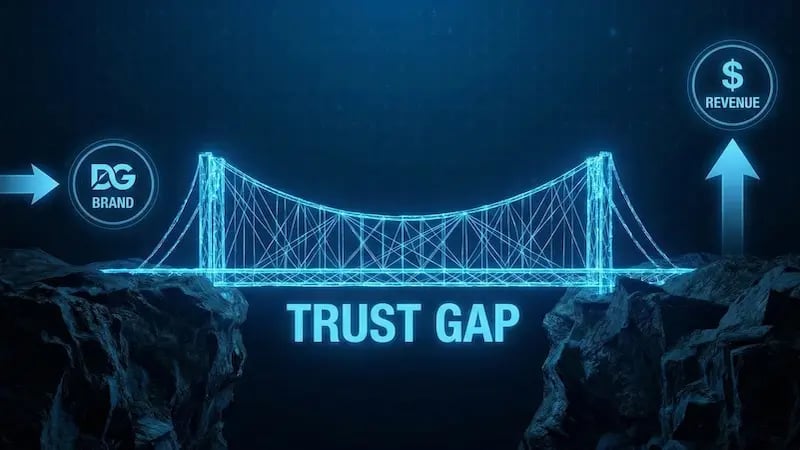
The "Trust Gap" refers to the measurable distance between what a brand promises in its marketing and what a customer actually believes, based on their experience and the brand's reputation.
-
The Promise: "Our software will save you 20 hours a week."
-
The Reality: Yes, but the customer sees a complex onboarding process, hidden fees, and a lack of support.
When this gap exists, marketing efficiency plummets. You can drive thousands of leads to a landing page, but if the "Trust Signals" are missing, those leads will never convert. The goal is to bridge that gap by utilizing data-driven inbound strategies that transform brand credibility from a vague concept into a tangible engine for growth.
Defining the Credibility Framework: The Three Pillars
Brand credibility is not a single, static metric. It is a dynamic intersection of three specific pillars that must work in harmony. If one pillar is weak, the entire structure of the brand's reputation is at risk.
Pillar 1: Expertise (The "Can You?" Factor)
Expertise answers the customer's fundamental question: Does this brand actually know what they are talking about? Expertise is proven through the depth of your content. It's the difference between a generic "Top 5 Tips" blog post and a white paper that uses original data to solve a complex industry problem.
-
The Proof: In 2026, expertise is verified by experience. Buyers look for brands that show they have been in the trenches. You don't just know how to solve the problem, you have solved it. This is why case studies and technical deep-dives are more effective than ever.
Pillar 2: Authoritativeness (The "Who Says?" Factor)
Authoritativeness refers to your brand's standing within the broader ecosystem. It's about being recognized as a leader or a "source of truth" by peers, third parties, and search engines.
-
The Ecosystem: Are you cited by other industry leaders? Does your brand win reputable awards? Do your executives speak at major conferences?
-
Third-Party Validation: This is the "Social Proof" element. While you can claim your own expertise, actual authority is granted to you by others. It is the votes of confidence from the digital world, such as high-quality backlinks and media mentions
Pillar 3: Trustworthiness (The "Will You?" Factor)
Trustworthiness is the moral and operational center of your brand. It asks: Does this brand consistently act with integrity, even when it's not convenient?
-
Transparency: This involves being open about pricing, admitting when a product isn't the right fit, and owning up to mistakes.
-
Integrity: It's the consistency of your "Say/Do" ratio. Trustworthiness is built over months of reliable performance but can be destroyed in a single afternoon of poor communication or data mishandling.

Credibility as the Engine, Trust as the Fuel
The relationship between these concepts is symbiotic.
Credibility is the engine: it is the mechanical structure of your brand's reputation, built through expertise and authority. However, an engine cannot move without fuel.
Trust is the fuel: it is the emotional energy provided by the customer that allows the engine to run.
Without both, your marketing efforts are merely noise in an already crowded room. High credibility with no trust makes you knowledgeable but unapproachable. High trust with no credibility makes you friendly but unreliable. You have to build both, ensuring your brand becomes a high-performance vehicle for client growth.
2. Implementing Trust as a Brand Foundation
Building credibility is not a task for the marketing department alone; it is a mandate for the entire organization. It begins with the realization that visibility without trust is a liability. If your marketing reach is high but your credibility is low, you are simply broadcasting your flaws to a larger audience.
Operationalizing Honesty
To build a truly credible brand, organizations must move toward Brand Participation. This involves actively living out your brand values through measurable actions, rather than merely "purpose-washing" with slogans. This also where consumers move from being passive receivers of advertisements to active contributors in a brand's narrative
Internal Alignment: The "Say/Do" Ratio
The "Say/Do" ratio is the ultimate internal metric for brand credibility.
-
Marketing says: "We are customer-obsessed."
-
Operations does: Makes it nearly impossible to cancel a subscription or reach a human in support.
When the "Do" does not match the "Say," credibility is destroyed instantly. To fix this, leadership must ensure that every department is aligned with the brand's trust-building mission. If transparency is a core value, it must be reflected in your contracts, your refund policies, and your public roadmap.
The Human-to-Human (H2H) Shift
In an era of AI automation, the most "premium" signal a brand can send is humanity. We are seeing a massive shift from B2B (Business-to-Business) to H2H (Human-to-Human) communication.
-
Empathy over Efficiency: Credible brands don't just solve problems; they acknowledge the stress those problems cause the customer.
-
The Voice of the Expert: Instead of "The Company is pleased to announce," use "Our Lead Engineer, Sarah, discovered a way to..." Putting a face and a name to your expertise increases trust by 35% compared to faceless corporate entities.

3. Closing the Gap: Strategies for Building Real Authority
The "Trust Gap" is more than a marketing hurdle; it is a structural failure in the relationship between a brand and its audience. Recent data reveals a jarring disconnect:
While 79% of B2C leaders believe they are trusted by their customers, only 52% of their customers agree.
This 27-point disparity is where sales are lost, and reputations crumble.
To bridge this gap, brands must move beyond superficial "about us" pages and implement a strategy of tactical transparency. This isn't about revealing trade secrets; it is about providing the information your customers need to feel safe making a decision.
The Tactical Transparency Framework
Tactical transparency is the practice of proactively addressing the "uncomfortable" parts of the buyer's journey. When you answer the questions your competitors are afraid to touch, you immediately ascend to the position of a trusted advisor.
A. The "Anti-Sales" Pitch: Admitting Limitations
One of the most powerful ways to build credibility is to tell a prospect when you are not the right fit.
-
The Strategy: Proactively list the types of companies or use cases where your product will fail to deliver maximum value.
-
The Result: This "honesty over the sale" creates a psychological anchor. When you eventually explain why you are the right fit for a different problem, the prospect believes you implicitly because you've already proven you prioritize their success over your commission.
B. Radical Pricing Clarity
Suspicion lives in the shadows of "Contact for Pricing" buttons. In the B2B world, transparency regarding costs is a massive trust signal.
-
The Framework: Even if your solution is highly customized, you can provide "Investment Ranges" or "Typical Project Costs."
-
The ROI: Providing pricing transparency reduces the "perceived risk" of a discovery call. It signals that you are "not playing games" and respect the buyer's time.
C. The "You Asked, We Answered" Content Loop
Every salesperson has a list of "tough questions" they dread. Instead of hiding from them, turn them into your primary content strategy.
-
The Execution: Publish articles titled "Why Our Product Costs More Than [Competitor]" or "Common Failures During Implementation and How We Fix Them."
-
The Psychological Trigger: This addresses the confirmation bias of the skeptic. If they are already looking for reasons to doubt you, seeing you address those doubts head-on disarms their skepticism.
Leveraging Inbound to Bridge the Gap
Inbound marketing is the "natural habitat" of credibility because it is inherently non-interrupted.
-
Educational Authority: By providing 5,000-word guides, technical white papers, and original research, you aren't asking for trust; you are demonstrating why you deserve it.
-
The 80/20 Rule of Content: To close the trust gap, 80% of your content must be dedicated to solving the reader's problem without a sales pitch. The remaining 20% can then bridge the gap to your specific solution. When you lead with value, you create reciprocity, a powerful psychological driver that makes the reader more open to your eventual sales message.

5. Social Media: The Modern Credibility Engine
Social media is no longer just a distribution channel for your blog posts; it is a real-time credibility laboratory. It is often the first place a prospect goes to perform a "proof of life" check on your brand. If your last post was three months ago, or if your comments section is a graveyard of unanswered questions, your credibility is compromised before the prospect even reaches your website.

The Power of Storytelling: Retention over Data
While statistics like the fact that high-trust brands report sales cycles up to 40% shorter build the logical case for your expertise, stories build the emotional connection required for trust. Social media is storytelling - it's a narrative about what your brand stands for, how your product is what they're looking for, and who you are as a company.
-
The retention gap: Research indicates that while only 5-10% of raw data is retained by audiences, 65-70% of information is retained when shared through storytelling.
-
Visible Operations (BTS): One of the most effective storytelling techniques for credibility is visible operations. By showing the behind-the-scenes (BTS) of how you solve problems, you demystify your process and reduce the perceived risk for the buyer. Brands that consistently post BTS content report a 41% higher engagement rate and significantly higher trust scores.
The 80/20 Rule of Digital Authority
To maintain authority on social platforms, you must resist the urge to turn your feed into a continuous sales pitch.
-
80% Value-Add: Educational content, industry trends, and "how-to" guides that solve problems for free.
-
20% Promotional: Direct calls to action, product updates, or webinar invites. When you lead with value, you build a trust reserve. When you eventually ask for a meeting or a sale, you are drawing from that reserve rather than overdrawing an empty account.
Deep Dive: Employee Advocacy and Executive Thought Leadership
A brand's credibility is the sum of the credibility of its people. In the B2B world, prospects trust a company's employees 3x more than the official corporate brand account. This is the foundation of employee advocacy.
The "Satellite Office" Framework
Every employee with a LinkedIn profile is a "satellite office" for your brand's credibility.
-
The Expert Voice: When an engineer shares a technical breakthrough, it carries more weight than a marketing professional sharing the same news. It proves that there are real experts "in the trenches."
-
Executive Presence: Founders and executives must act as the "Chief Credibility Officers." By sharing their perspectives on industry challenges and, crucially, their mistakes, they humanize the organization.
-
The H2H Shift: Moving from B2B (Business-to-Business) to H2H (Human-to-Human) means allowing your employees to show their personalities. Authenticity is the antidote to the "uncanny valley" of AI-generated corporate content.
6. Tactical Execution: The Credibility Audit
To bridge the Trust Gap, you must first measure it. A credibility audit identifies the points in your customer journey where trust is leaking.
The Five Key Audit Points:
-
The "First Impression" Audit: Does your website load in under 3 seconds? Does it have an SSL certificate? Are your visuals consistent? (Technical Trust).
-
The "Proof of Success" Audit: Are your case studies up to date? Do they include specific, measurable ROI, or are they filled with vague fluff? (Expertise Trust).
-
The "Say/Do" Audit: Go through your marketing copy and highlight every promise made. Then, interview your customer success team to see if those promises are being kept. (Operational Trust).
-
The "Accessibility" Audit: How hard is it to find a human to talk to? If a prospect has a question, can they receive an answer within 24 hours? (Relational Trust).
-
The "Social Proof" Audit: What do third-party sites (G2, Capterra, Google Reviews) say about you? Are you responding to negative reviews with accountability and transparency? (Authoritative Trust).