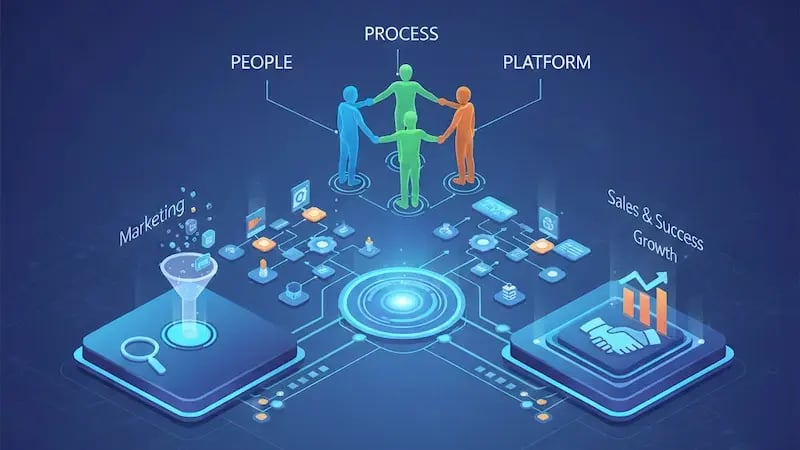
The High Cost of an Idling Revenue Engine
The difference between a market leader and a struggling enterprise isn't just the quality of the product; it is the efficiency of the growth engine. Many organizations find themselves trapped in a cycle in which they work harder each quarter but see diminishing returns—a phenomenon we call an "idling growth engine."You have the fuel (leads) and the machinery (sales and marketing teams), but if your transmission—your CRM—is slipping, you are wasting energy, capital, and time.
Why is this happening now? The B2B buying landscape has undergone a seismic shift.
According to Gartner, B2B buyers spend only 17% of their total purchase journey meeting with potential suppliers.
When you consider that they are likely looking at three different vendors,
Your specific sales team might only get 5% or 6% of their total attention.
If your internal systems are fragmented, that tiny window of face time is spent correcting data errors rather than closing deals.
The Stat: Companies with aligned Revenue Operations (RevOps) functions grow 19% faster and achieve 15% higher profitability than those without aligned RevOps.
RevOps is the grease in the gears that ensures your CRM isn't just a digital filing cabinet, but a dynamic source of truth. Without it, you aren't just losing efficiency; you are paying a Complexity Tax that erodes your margins every single day.

RevOps 101: Moving Beyond "Sales Support"
Historically, Operations was a back-office, reactive function. Marketing had its tools, Sales had its CRM, and Customer Success had its spreadsheets. Each department was its own island, with its own metrics, goals, and definition of "success."
In this old model, Sales Ops was essentially Sales Support—helping reps with quotes or troubleshooting CRM logins. Marketing Ops was Email Support—blasting out newsletters and managing list imports. This siloed approach is no longer sustainable in a world where customers expect a seamless, unified experience across every touchpoint.
Why the Funnel is Broken: The Death of the Linear Journey
The traditional linear funnel—Awareness, Consideration, Decision—assumes a customer moves neatly from one stage to the next and then disappears into the "Success" void. This model is fundamentally flawed for three reasons:
-
It Ignores Post-Sale Revenue: In most B2B and SaaS models, the real profit is made after the initial deal. The funnel ends at the point of purchase, treating current customers as an afterthought rather than your most valuable source of new growth.
-
It Creates Data Gaps: When Marketing's job ends at Leads, and Sales' job begins at Deals, a massive amount of intelligence is lost in the handoff. Sales doesn't know which content the lead consumed, and Marketing doesn't know why those leads ultimately failed to close.
-
It Frustrates the Buyer: If a prospect has to repeat their pain points to three different people in three different departments, they feel like a number, not a partner.
The Paradigm Shift: From Funnel to Lifecycle Revenue (The Flywheel)
Revenue Operations replaces the funnel with a Lifecycle Revenue Model, often visualized as a Flywheel. In this model, the customer is at the center, and the energy generated by each department is fed back into the engine to drive further growth.
-
Marketing as Revenue Sourcing: Instead of just generating "clicks,"
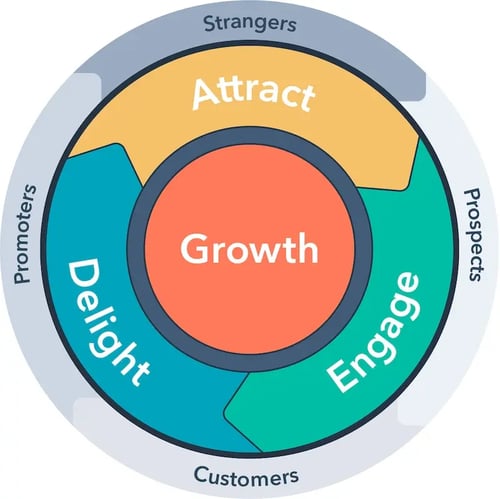 Marketing is held accountable for Pipeline Contribution. They use RevOps data to see which channels produce the highest LTV (Lifetime Value) customers, not just the cheapest leads.
 -
Sales as Relationship Architecture: With RevOps, Sales reps move away from data entry and toward high-value coaching. They enter conversations armed with a complete behavioral history of the prospect, allowing them to lead with value rather than discovery questions.
-
Service as Expansion & Retention: Customer Success becomes a proactive revenue driver. Because they are on the same platform, they can see exactly what was promised during the sales cycle and use Product Qualified signals to identify upsell opportunities before the renewal date.
The Three Pillars of RevOps Alignment
To move beyond "Sales Support," RevOps must align three specific areas of the business:
Alignment Pillar |
The Siloed Experience |
The RevOps Experience |
|---|---|---|
Data Alignment |
Each team has a different "Source of Truth." |
One unified database (HubSpot) for all departments. |
Metric Alignment |
Marketing wants "Leads"; Sales wants "Revenue." |
Everyone is focused on "Net Revenue Retention" and "LVR." |
Tech Alignment |
A "Franken-stack" of 15 tools that don't talk. |
A consolidated platform with native integrations. |
The Strategic ROI of Alignment
When you bridge the gap between these silos, you see measurable results.
Statistics show that businesses with high alignment between sales and marketing see 36% higher customer retention and 38% higher sales win rates.
Furthermore, according to a study by Forrester,
Companies that align their revenue processes across the entire lifecycle see a 10% to 20% increase in sales productivity.
This isn't just about "playing nice" between teams; it is about reclaiming the leakage that occurs whenever a prospect or customer moves from one department to another.
The "Messy Middle": Where Revenue Goes to Die
The most critical part of RevOps 101 is solving the "Messy Middle." This is the psychological and operational No Man’s Land where a marketing lead is "hot" but hasn't yet been accepted by Sales.
In a siloed model, this stage is a black hole. In a RevOps model, this stage is governed by Service Level Agreements (SLAs) and automated triggers. If a lead hits a certain behavioral score, they are automatically routed, a task is created for the rep, and if that rep doesn't follow up in 2 hours, the lead is re-routed to ensure zero lead decay.
The Core Framework: People, Process, and Platform
To keep a CRM running smoothly, you must balance three competing pillars. Most businesses fail because they over-invest in the Platform (the software) while neglecting the People (the experts) and the Process (the rules of the road). Without this balance, you don't have a revenue engine; you have an expensive piece of software that your team resents.
The People: The Talent Paradox
The biggest bottleneck in RevOps isn't technology—it's expertise. As your HubSpot portal grows in complexity, you face a Talent Paradox: you need high-level systems architecture to build the engine, but you only need day-to-day administration to keep it running.
The Admin Accelerator vs. The Full-Time Hire
One of the most common strategic errors we see is hiring a full-time HubSpot Admin too early. A mid-level admin (average salary ~$95k-$120k) is often great at "doing the work" but lacks the architectural experience to "design the system."
-
The Cost of In-House: Beyond the six-figure salary, you have overhead, benefits, and the "Single Point of Failure." If your admin leaves, your institutional knowledge leaves with them.
-
The RevOps as a Service (Fractional) Model: This provides a team of specialists—an architect for the big picture, a developer for the custom code, and an analyst for the reporting—for the cost of one mid-level hire. This ensures your system is built to scale from the start.
The Process: Engineering the "Rules of Engagement"
Process is the "code" that runs your business. If your process is broken, the CRM will simply help you fail faster. RevOps alignment requires a fundamental redesign of how departments interact.
Breaking the "Silos of Silence"
In many organizations, the sales team doesn't know what marketing is doing, and the service team is the last to know when a deal is closed. RevOps breaks these silos through Service Level Agreements (SLAs).
-
Marketing to Sales SLA: "We will deliver 50 SQLs a month with a minimum lead score of 70."
-
Sales to Marketing SLA: "We will contact every SQL within 4 hours and update the 'Lead Status' field immediately."
Automating the Handoff
The "handoff" is where most leads rot. Modern RevOps uses Automated Lead Routing to remove the human element of "assigning" leads. Based on territory, industry, or company size, HubSpot can instantly route a lead to the right rep, send a Slack notification, and create a "follow-up" task with a due date of "Now."
The Platform: Choosing Your Growth Foundation
The platform is the physical infrastructure of your revenue engine. While there are hundreds of tools on the market, the decision usually boils down to the "Unified" vs. "Best-of-Breed" debate.
HubSpot vs. Salesforce: The Integration Tax
Many companies choose Salesforce for its extensive customization. However, that customization comes with a high "Integration Tax"—the hidden cost of paying developers to make separate marketing and service tools talk to the CRM.
-
The HubSpot Advantage: Because HubSpot was built on a single, unified codebase, your Marketing, Sales, and Service tools share the same "DNA." When a customer clicks an email, the contact record is updated instantly. When a deal closes, the onboarding workflow is automatically triggered.
-
The Result: High adoption. A CRM is only as good as the data entered into it. HubSpot's user-friendly interface drives higher rep adoption, which yields cleaner data and better business decisions.

The Interdependency: Why You Need All Three
-
People + Platform (No Process): You have smart people and great tools, but they are all working in different directions. The result is "Random Acts of Marketing."
-
Process + Platform (No People): You have a great system, but no one knows how to fix it when it breaks or optimize it as the market shifts.
-
People + Process (No Platform): Your team is aligned and has great ideas, but they are drowning in manual spreadsheets and data entry.
The Strategy: To achieve Reliable Growth, you must treat these three pillars as a single ecosystem. At Aspiration Marketing, we specialize in bridging these gaps—providing the People (architects), designing the Process (SLAs), and optimizing the Platform (HubSpot) to ensure your revenue engine is always running at peak performance.

The "Messy Middle": Automating the MQL to SQL Handoff
As we've mentioned above, this is where revenue goes to die. Marketing claims they sent "great leads," while Sales claims those leads were "junk." Without a technical bridge, this finger-pointing becomes the default culture.
The Psychological Toll of the Manual Handoff
When the handoff is manual, it relies on human memory and "best effort" communication. This creates two major points of failure:
-
The Delay: Research shows that the odds of qualifying a lead drop by 10x if you wait just one hour to follow up. By the time a marketing manager manually exports a list and emails it to a sales rep, the prospect has already moved on to a competitor.
-
The Information Gap: If a rep receives a lead but doesn't know why that lead is interested (e.g., they downloaded a "Pricing Guide" for a specific product), the first call feels like a cold call. The prospect feels misunderstood, and the rep feels unprepared.
That's why you need to have a plan well before you start selling.
What Does Submit Even Mean?
The first step is to conduct an internal audit to identify a few key considerations.
A Technical RevOps Partner asks: "What happens the second they click 'Submit'?"
-
Which workflow triggers?
-
How is the 'Lead Status' updated?
-
What internal notification is sent to the rep?
-
How do we measure the "Time to First Action"?
All these, and more, are critical to keep in mind when moving on to the next step: the SLA.
Engineering the Service Level Agreement (SLA)
A Revenue Operations strategy replaces "best effort" with a technical Service Level Agreement (SLA). This isn't just a document; it is a set of automated triggers inside HubSpot that hold both teams accountable.
-
Definition of a Lead: Marketing and Sales must agree on exactly which properties define an MQL. Is it a specific job title? A certain company size? A threshold of behavioral "points"?
-
The Response Mandate: The SLA might dictate that every SQL must be contacted within 4 hours.
-
The Feedback Loop: If Sales rejects a lead, they must select a Reason Code (e.g., Wrong Persona, No Budget). RevOps then pipes this data back to Marketing to refine their ad targeting.
Automated Lead Routing: The "Fairness Engine"
Manual lead assignment is often viewed by sales teams as "playing favorites." RevOps removes this friction through Automated Routing.
-
Round Robin: Automatically distributes leads to the next available rep to ensure an even workload.
-
Weighted Routing: Assigns more leads to your high performers or specialized reps in specific industries.
-
Territory Mapping: Uses the prospect's IP address or zip code to instantly route them to the local account executive.
Solving the "Lead Decay" Problem
Lead decay is the silent erosion of your marketing ROI.
Statistics show that responding to a lead within 5 minutes makes you 21x more likely to qualify them than waiting 30 minutes.
Technical RevOps solves this through Real-Time Intelligence. Using the HubSpot Sales Hub, you can set up Slack or Microsoft Teams integrations that ping a salesperson the second a high-value prospect opens an email or visits the pricing page. This allows for "In-the-Moment" outreach, where the rep calls while the prospect is actively thinking about the solution.
By focusing on the "Messy Middle," you ensure that the money you spend on marketing actually results in closed deals. You move from "throwing leads over the fence" to a unified, high-speed relay race where the baton is never dropped.

Technical RevOps: Engineering the "Source of Truth"
Now that we've covered what RevOps is, why you need it, and who needs to be involved, let's look at how to do it. Technical RevOps is the process of architecting a database that doesn't just store information but actively drives revenue through precision and automation.
At this level, we move beyond "standard" features. We are no longer just sending emails or tracking calls; we are engineering a system that understands the nuances of your specific business model.
Custom Objects: Breaking the Standard CRM Mold
Standard CRMs are built on a rigid foundation: Contacts, Companies, Deals, and Tickets. For a simple product company, this is enough. But for high-growth firms with complex models, or a non-traditional institution that requires intricate detail tracking and stakeholder accountability, these standard buckets are a straitjacket
Custom Objects allow you to extend the HubSpot schema to track exactly what matters to your business. A great example would be education.
-
The Industry Spotlight: In our experience with the education sector, a Contact isn't just a person; they are a Student associated with a Program, a Cohort, and a Financial Aid Application.By building these as Custom Objects, you can trigger automations based on Program Enrollment or Certification Expirationjust as easily as you would a Deal Stage.
-
The Logic: If you find yourself using Custom Properties to store data that should really be its own record (e.g., creating 20 properties to track different details of a single piece of equipment), you are ready for Custom Objects.
Programmable Data: Solving the "Impossible" Workflow
Standard workflows are built on "If/Then" logic. While powerful, they have limits. What happens if you need to calculate a complex weighted lead score based on data sitting in an external SQL database? Or what if you need to format a string of text into a specific code for your fulfillment team?
This is where Programmable Automation comes in. By using JavaScript or Python inside HubSpot's Data Hub, Technical RevOps can:
-
Execute External API Calls: Pull real-time shipping data or credit scores into a HubSpot record.
-
Perform Complex Math: Calculate advanced commissions or multi-year contract values that standard properties can't handle.
-
Data Normalization: Automatically fix formatting issues (like names in ALL CAPS or mismatched phone extensions) before they reach your sales team.
Technical Architecture & The "Say/Do" Ratio
In the context of Revenue Operations and Brand Credibility, the "Say/Do" Ratio is a critical performance and trust metric that measures the alignment between a company's external promises (the "Say") and its internal operational delivery (the "Do").
It is the primary indicator of Operational Integrity.
Defining the Ratio
-
The "Say": This encompasses your marketing claims, sales promises, Service Level Agreements (SLAs), and brand values. (e.g., "We respond to all inquiries within 2 hours.")
-
The "Do": This is the measurable reality of the customer experience. (e.g., The actual average response time is 14 hours.)
A high Say/Do ratio (close to 1:1) indicates a credible, well-oiled revenue engine. A low ratio indicates organizational friction, where marketing and sales are making promises that the technical infrastructure or the service team cannot support. This misalignment is the leading cause of trust decay, customer churn, and very inefficient RevOps.
The Governance Plan: Protecting Your Investment
A sophisticated technical architecture is only as good as the guardrails that protect it. A Governance Plan is a non-negotiable asset for any company scaling toward Enterprise. This document acts as the "source of truth" for the system itself, defining:
-
Naming Conventions: Ensuring every campaign and workflow follows a readable, searchable format (e.g., [Region]_[Department]_[Campaign Name]_[Date]).
-
Permission Tiers: Defining who has the "keys to the kingdom." High-level architects should be the only ones creating properties or modifying integrations.
-
Data Deletion Policies: How do you handle "unengaged" contacts to keep your subscription costs low and your deliverability high?
Why is this critical? In data science, there is a concept known as the "1-10-100 Rule."
-
It costs $1 to verify a record when you first get it.
-
It costs $10 to clean and scrub that record later.
-
It costs $100 (in lost opportunities, bad reputation, and wasted labor) if you do nothing and let the record stay "dirty."
When your CRM is well-governed, your sales reps can spend their time selling
The transition from a startup to a scale-up is often the moment when governance becomes a must-have rather than a nice-to-have. You can manage a CRM for five people with a few verbal agreements and a shared sense of "how we do things." You cannot manage a CRM for 50 or 500 people that way. As your organization grows, the complexity of your data increases exponentially. Without a framework to manage that complexity, your growth will eventually stall as your team becomes bogged down by administrative friction.

Data Integrity: The Silent Revenue Killer
If your data is "dirty," your leads are rotting. It is an uncomfortable truth that many leaders ignore because data cleaning is perceived as "unproductive" back-office work. However, in a RevOps framework, data integrity is a primary driver of your Customer Acquisition Cost (CAC) and your Sales Velocity.
The Statistics of Decay
Data doesn't stay clean on its own. It is estimated that
B2B data decays at a rate of roughly 2.1% per month (or about 25% per year).
People change jobs, companies merge, and email domains expire. Other sobering statistics include:
-
Bad data costs the U.S. economy $ 3.1 trillion annually.
-
Sales reps spend nearly 30% of their time searching for information or correcting data—time that should be spent selling.
-
40% of all B2B leads have inaccurate or missing data fields.
The "Trust Tax" and Sales Friction
The most significant impact of poor data integrity isn't just a technical error; it's the erosion of trust. We call this the "Trust Tax."
This can spiral out of control in two different ways:
Internal Trust Tax: When a sales rep follows up on a lead and discovers that the Company Name is actually a URL or that the Phone Number is missing a digit, they lose faith in the Marketing team and the CRM. Eventually, they stop using the CRM altogether and retreat to private spreadsheets.
External Trust Tax: Imagine sending an automated personalized email that starts with "Hello {FIRSTNAME_UNKNOWN}" or references the wrong industry. You haven't just missed a lead; you've signaled to the prospect that you are disorganized and inauthentic.
The "Big Three" of Data Corruption
Technical RevOps focuses on identifying and neutralizing the three primary types of data corruption:
-
Duplicates: When one person exists as three separate contact records, you can't see their full journey. Marketing might keep emailing someone who is already deep in a sales conversation with a rep.
-
Inconsistent Formatting: Is it "VP of Sales," "V.P. Sales," or "Sales Vice President"? Without data normalization or a standard way to phrase information, your segmentation and reporting become impossible.
-
Missing "Source" Data: If you don't know where your leads come from (Organic, Paid, Social), you cannot calculate the ROI of your marketing spend. You are essentially flying blind.
Global RevOps: Managing Complexity at Scale
For companies operating across borders, things get a little more complex. Here, data integrity becomes a matter of legal compliance.
In addition to the usual data-cleaning considerations, there are global factors to take into account, such as:
-
Multi-Portal Management: How do you ensure that a lead who opts out of marketing in Germany (under GDPR) isn't accidentally emailed by a rep in the US?
-
Currency and Language: Global RevOps requires a unified schema in which Revenue is converted to a base currency for the CFO, while local teams can continue working in their native currencies.
-
Data Partitioning: Ensuring that sensitive data is only visible to those who need it, protecting both the customer's privacy and the company's liability.

The Solution: Automated Data Hygiene
You cannot "manually" keep a CRM clean once you pass a certain volume of leads. You need automated hygiene "bots."
-
Validation Workflows: Using HubSpot to automatically flag records with missing key fields (like Industry or Job Title).
-
De-duplication Software: Utilizing tools like Insycle or native HubSpot AI to merge duplicates based on email domain and name logic.
-
Third-Party Enrichment: Automatically pulling in data from sources like Clearbit or ZoomInfo to "fill in the blanks" of your contact records the second a form is submitted.
At Aspiration Marketing, we believe that clean data can be the ultimate competitive advantage. It enables more precise targeting, faster sales cycles, and reporting you can take to a Board meeting with confidence. We don't just "import" your lists; we architect a data firewall that prevents junk from entering your system in the first place.

Proving ROI to the CFO: Metrics That Matter
To get the budget for RevOps, you must move away from "Vanity Metrics" like "Impressions" and "Clicks" and start talking about Financial Outcomes.
The Strategic Metrics:
-
Total Cost of Ownership (TCO): By moving from 12 disconnected tools to one unified HubSpot portal, how much are we saving in licensing fees and integration maintenance?
-
Lead Velocity Rate (LVR): How quickly is our pipeline growing month-over-month?
-
Customer Lifetime Value (LTV) to CAC Ratio: Are we spending $10 to make $100, or $90 to make $100?
The Financial Argument: RevOps isn't a cost center; it's a revenue multiplier. If a RevOps audit identifies and removes $50,000 in redundant software costs and reclaims 20 hours a week of sales rep time, the investment pays for itself before you even consider the increase in closed-won deals.

The Future-Proof Scale: Pro to Enterprise
As your business scales, your CRM must scale with you. Many companies start on the Starter or Professional tiers, but there comes a point when Enterprise becomes a necessity, not a luxury.
When to Pull the Trigger on Enterprise:
-
Sandboxes: Essential for testing complex code or new integrations without breaking your live database.
-
Business Units: If you acquire a new company or launch a second brand, you need separate data partitions while maintaining a single parent "Source of Truth."
-
Predictive Lead Scoring: Using AI to analyze thousands of data points to tell you exactly which lead is most likely to close.
-
Advanced Permissions: Ensuring that your regional teams only see the data they are legally allowed to access.
Future-proofing means building your portal today so that an upgrade tomorrow is a "feature unlock," not a "re-implementation."
Finding Clarity And Growth
At the end of the day, Revenue Operations is about clarity. It is about removing the friction between your brand and your buyer. In an era where AI can generate infinite amounts of "fluff" content, the companies that win will be those with the best technical architecture and the most reliable data.
At Aspiration Marketing, we pride ourselves on being the "Anti-Agency." We are technical architects and RevOps consultants who prioritize systems over slogans. We understand that a CRM is only as good as the processes that power it and the people who manage it. Pretty templates won't fix a broken handoff, and creative copy won't clean up a decade of dirty data.
Whether you are struggling with a "Franken-stack" of disconnected tools, facing a high-stakes Salesforce migration, or simply need to prove the ROI of your HubSpot investment, we provide the technical expertise to keep your CRM running smoothly. We don't just provide marketing; we engineer revenue engines. It's time to stop guessing and start engineering your growth.