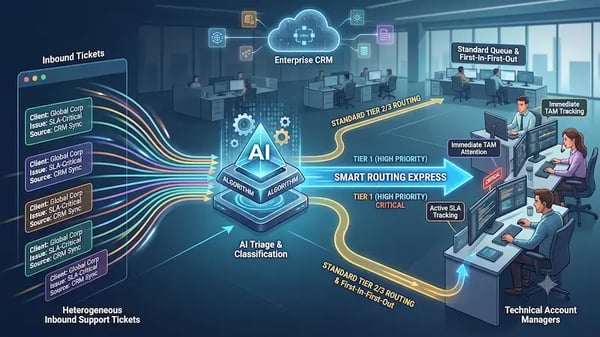
Have you noticed how your own search habits have changed lately? A few years ago, you likely typed "best CRM for enterprise" into a search bar and clicked through a list of blue links. Today, you are more likely to ask an AI: "Which CRM should I use for a global team of 500 that needs heavy automation?"
Suddenly, that blue link is irrelevant. Being the answer is all that matters.
The digital landscape has shifted. We are moving from a world of "searching" to a world of "asking." For enterprise leaders, this shift isn't just about marketing; it's about survival. Traditional SEO gets you in the room. Answer Engine Optimization (AEO) gets you quoted. Generative Engine Optimization (GEO) gets you trusted as the top recommendation by an AI's reasoning engine. And all of the above are ways you can scale your business revenue and drive growth.
But if your growth engine feels like it is idling, it might be because your technical foundation is built for the web of 2020, not the AI-driven economy of today. To scale enterprise revenue today, you must align your Revenue Operations (RevOps) with the way machines now consume data.
The Evolution of Search: AEO vs. GEO

To truly master the modern digital landscape, enterprise leaders must move beyond the basic terminology of "AI marketing" and understand the nuanced hierarchy of the new search economy. The shift from traditional Search Engine Optimization (SEO) to a dual-layered strategy of Answer Engine Optimization (AEO) and Generative Engine Optimization (GEO) represents the most significant change in information retrieval since the invention of the smartphone.
Understanding the Hierarchy: From Links to Logic
For decades, SEO was the bedrock of growth. It was a game of "infrastructure"—ensuring your site was crawlable and fast so Google could point a user to your book in the digital library. But in 2026, the internet is no longer just a library; it is a research laboratory. While traditional SEO still serves as your foundation by ensuring you are indexable, it is no longer the final goal. To stay relevant, you must layer AEO and GEO on top of that foundation.
Answer Engine Optimization (AEO) is the transactional layer. It is about being the immediate, direct response to a user’s specific query. When a user asks a smart speaker, "What is the implementation time for HubSpot Breeze?", they aren't looking for a long-form story or a "Top 10" list. They want a specific, accurate fact. AEO is the technical art of "hand-feeding" these facts to AI models so they can be extracted with zero friction.
Generative Engine Optimization (GEO) is the strategic layer. It focuses on the reasoning engines of Large Language Models (LLMs) like ChatGPT, Claude, and Perplexity. GEO isn't just about providing a fact; it’s about influencing the sentiment, authority, and citation frequency of your brand. If AEO gets you quoted, GEO gets you recommended as the definitive solution during an AI's synthesis process.
The Urgency of the "Search Fatigue" Pivot
The move toward AEO and GEO isn't just a technical trend; it is a response to a massive shift in consumer behavior. Recent data from a 2026 Search Engine Land study reveals that 37% of consumers now start their searches with AI tools rather than traditional search engines.
This data highlights a growing "search fatigue." Users are increasingly frustrated by the "blue link" experience—scrolling through pages of ads and fluff to find a simple answer. They now prefer a single, synthesized response that does the research for them. This creates a "Zero-Click" world; current studies show that nearly 60% of Google searches now end without a single click to a website. If your brand is not the "cited source" within that synthesized answer, you have become effectively invisible to more than a third of your potential market.
Strategic Layering: How to Win the Answer Economy
To win in this environment, enterprise content must move away from "SEO fluff"—repetitive introductions and long-winded prose designed to keep a human on a page—and move toward Machine-Readability. AI models prioritize "answer density." They crave facts, structured logic, and verified data.
Research indicates that specific optimizations—such as adding authoritative citations and statistics to your own content—can increase your visibility in AI responses by up to 40%. Furthermore, sites that utilize robust structured data and "Answer-First" architecture see a 44% to 67% increase in being selected as a primary source by AI engines.
By focusing on your GEO footprint today, you are future-proofing your brand. It is about building a digital reputation so consistent and machine-readable that the AI cannot help but cite you as the authority. In the era of the "Answer Economy," you are either the source of the data or you are invisible.

Agentic AEO: Optimizing for the "Task-Bot" Economy
The digital landscape has reached a tipping point where the "Chatbot" era is rapidly evolving into the Agentic Era. For enterprise RevOps leaders, this represents a fundamental shift from optimizing for conversations to optimizing for actions. While a standard chatbot like the original ChatGPT was designed to summarize a blog post or explain a concept, the new generation of AI—specifically, HubSpot Breeze AI Agents and OpenAI's autonomous frameworks—is designed to execute complex business workflows with zero human intervention.
From Answering Questions to Executing Tasks
In the traditional search economy, people went online to read and learn. In the Task-Bot Economy, the internet acts as a massive, interconnected API. Chief Innovation Officers and RevOps directors are increasingly deploying these autonomous agents to handle the "drudge work" of the procurement and sales cycles.
Think about the difference in intent:
-
The GEO Query: A user asks, "Who are the top enterprise HubSpot partners for manufacturing?" and the AI mentions your brand as a "top provider."
-
The Agentic Task: A task-bot is told, "Audit our current security vendors and find a replacement that offers 24/7 monitoring, verify their SOC2 compliance, and book a meeting with a rep if they are under $40k/year."
The agent doesn't need a clever summary or flowery prose. It needs structured data points. If your pricing is buried in a gated PDF or your compliance certifications are hidden behind a Contact Us wall, the agent will simply skip you. In the world of Agentic AEO, friction isn't just a nuisance; it is a terminal flaw.
According to a Gartner report, roughly 20% of customer service interactions are now handled by autonomous AI agents, and that number is scaling "up-funnel" into B2B vendor shortlisting.
Furthermore, the same study suggests that,
Agentic AI will autonomously resolve 80% of common customer service issues without human intervention, leading to a 30% reduction in operational costs.
The Three Pillars of Action-Ready Agentic AEO
To win in an economy where bots are the gatekeepers of the vendor shortlist, your digital presence must move toward Technical Interoperability. You must build "hooks" that an AI agent can grab onto.
1. Machine-Readable Tiers and Pricing
Transparency is no longer optional. AI agents use tool-calling functions to search for specific schemas, like PriceSpecification or Product markup, within your HTML. When an agent can instantly see that "Tier A" includes "Feature X" for "Price Y," it can check that box and move you to the next stage of the buyer's journey.
Organizations that adopt these autonomous workflows are seeing massive productivity gains, with Goldman Sachs estimating that AI-driven automation could boost global GDP by 7%.
2. Clean DOM Structures and API-First Content
Your website is no longer just a visual experience; it is a data source. This means your technical stack must be pristine. Agents struggle with heavy JavaScript overlays or layouts that hide text behind hover states. Successful Agentic AEO requires JSON-LD for everything—from your executive team's credentials to your specific service level agreements (SLAs).
3. Trust and Verification (The Agent's RFP)
Agents are programmed to be skeptical; they look for "Proof of Work." If an agent finds a claim on your site, it will look for a secondary source—such as a G2 review, a mention in a reputable trade journal, or a SOC2 repository—to verify it.
The Transformation of the Lead Flow
We are seeing a shift toward Agent-Verified Forms. These allow a user's AI assistant to provide a cryptographically signed token that proves it is acting on behalf of a real human. This allows the agent to book a slot directly on your sales team's calendar.
The question for enterprise leaders is simple: Is your lead-capture process actionable for a machine? If the answer is "no," you are leaving revenue on the table for competitors who have already embraced the Agentic AEO strategy. By making it easy for bots to find, verify, and act on your data, you ensure that your brand is the path of least resistance in the autonomous economy.

The RevOps Architecture: Building a Single Source of Truth (SSOT)

The Silent Revenue Killer: The "Dirty Data" Crisis
How much of your enterprise CRM data can you actually trust right now? If you are being honest, the answer is likely unsettling. Many revenue leaders spend millions of dollars on sophisticated, cutting-edge tech stacks, yet their sales representatives are still dialing inactive phone numbers, and marketing teams are still blasting emails to ghost accounts. This is not just a minor technical annoyance; it is a systemic financial drain.
An AI is only as smart as the data it consumes. If your CRM is a mess of duplicates, fragmented records, and ambiguous, free-text sales notes, your artificial intelligence initiatives will fail. This is the reality of the "Dirty Data" crisis.
According to a Gartner study, poor data quality costs organizations an average of $12.9 million per year in wasted resources, missed opportunities, and operational friction.
Compounding this issue is the reality that corporate information does not remain static.
According to HubSpot, B2B data rots at an alarming rate of roughly 30% every year.
People change jobs, companies merge, domains expire, and internal job titles shift. During periods of high economic volatility or corporate restructuring, email-specific decay alone can spike dramatically in a single month. This constant degradation creates a form of "data debt" that compounds over time. When you attempt to plug a high-end AI tool, a large language model (LLM), or an autonomous prospecting agent into an unvanned repository, the system encounters immense noise.
Instead of generating strategic revenue breakthroughs, the AI finds itself in a chaotic environment. To bridge the gap between human interpretation and algorithmic precision, the enterprise requires a complete structural reset.
HubSpot as Your AI Foundation
Establishing a Single Source of Truth (SSOT) within HubSpot is the definitive answer to data debt. However, this shift requires a complete change in perspective. This is not just about a temporary, manual "spring cleaning" of your contact lists or running an occasional deduplication script. It is about engineering an intentional, rigid data architecture where every customer interaction, operational property, and system touchpoint is meticulously structured for machine ingestion.
Historically, CRMs were built as digital filing cabinets for human eyes. Humans are remarkably adept at reading between the lines, deciphering context from fragmented notes, and understanding typos. If a sales representative writes "had a good call, prospect interested" in a free-text field, another human can infer the general sentiment. To an AI agent or a private LLM model, that note is entirely useless noise. It lacks specific, distinct, and quantifiable parameters.
When an AI tries to execute a predictive forecast, score a lead, or build an autonomous email sequence based on vague inputs, it is forced to guess. In the world of enterprise software, an algorithmic guess manifests as a hallucination—a false, distorted reflection of business intelligence that can lead to incredibly expensive strategic errors. You cannot afford to train an enterprise model on a multi-million dollar data mistake.
Machine-Readability via Semantic Triples
To turn HubSpot into a true foundation for private AI training and agentic automation, the data must be machine-readable. This is achieved by transitioning away from free-form content entry and moving toward a standardized linguistic framework known as Semantic Triples.
A semantic triple structures information into a highly logical, immutable format: Subject → Verb → Object.
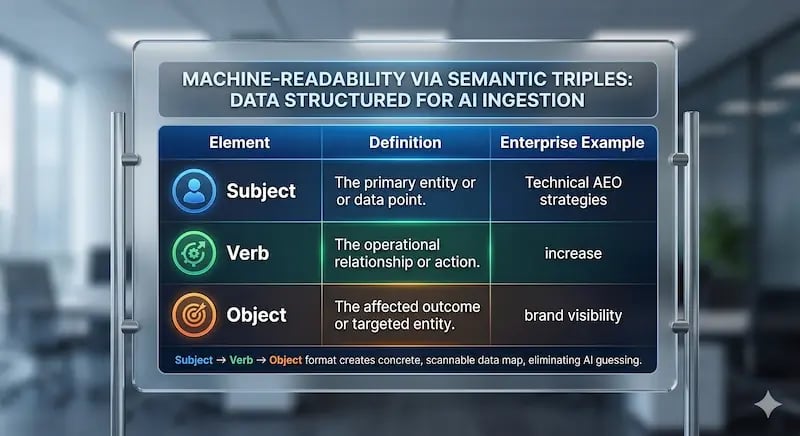
By enforcing this level of relational logic across your HubSpot properties, you create a concrete, scannable map. For instance, instead of allowing a salesperson to write a paragraph about a discount negotiation, the system records strict data points: [Deal ID X] → Requires → [15% Discount Approval].
When your data architecture strictly follows this logic, the AI never has to guess or fill in blanks. It can instantly track the direct, unbroken line from an initial top-of-funnel marketing click through mid-funnel content consumption to a closed-won enterprise deal. It builds a flawless internal knowledge graph. This explicit clarity completely eliminates the risk of hallucinations, allowing your autonomous workflows to trigger with absolute precision.
Safeguarding the Architecture: The 1-10-100 Rule
Maintaining an AI-ready Single Source of Truth requires structural guardrails to stop bad data from entering the database in the first place. In data operations, this is governed by the classic 1-10-100 Rule of data quality:
$1 to Verify: It costs a business approximately $1 to validate a record as it enters the system via automated validation rules.
$10 to Clean: It costs $10 to manually clean, enrich, and de-duplicate that same record once it has settled into the database.
$100 in Losses: It costs $100 in lost revenue, eroded brand reputation, and wasted sales hours if the record is left dirty and an AI misinterprets it.
Enterprise RevOps teams must utilize HubSpot to build a technological firewall. This involves mapping clear dropdown taxonomies, eliminating free-text fields where a conditional checkbox would be more appropriate, and leveraging third-party enrichment tools to validate data fields in real time. By changing your organizational data culture and treating your CRM as a dynamic, living data asset, you shift from reactive troubleshooting to proactive growth. Clean data feeds your autonomous pipeline, turning your internal portal into your most valuable, uncopyable corporate moat.
The Role of the AI Orchestrator
Defining the Symphony: From Tool User to Conductor
 If 2024 was about learning to talk to a chatbot and 2025 was about deploying disconnected, single-use automation, then today is officially the year of the AI Orchestrator. This is not a subtle software update or a passing corporate trend; it represents a fundamental, structural shift in how Revenue Operations (RevOps) functions across the enterprise. We have moved past the initial novelty of generative AI tools. Today, revenue leaders face a much more demanding challenge: managing a sprawling ecosystem of automated agents without introducing chaotic operational friction.
The AI Orchestrator is the critical human "conductor" of this autonomous revenue symphony. They do not necessarily write the underlying machine learning code, but they are the master architects who design the data workflows and operational rules of engagement. In a modern enterprise tech stack, you might have:
-
One embedded AI agent running top-of-funnel outbound prospecting.
-
A separate agent managing mid-funnel lead qualification.
-
A third agent is handling post-sale customer support.
Without strict centralized orchestration, these tools naturally create automated silos—the prospecting bot might continue sending aggressive upsell sequences to an account that just opened a high-priority customer service complaint ticket.
The AI Orchestrator bridges these technical gaps. They implement the "connective tissue"—using advanced orchestration layers within platforms like HubSpot Breeze AI—to ensure every tool shares a unified memory. Furthermore, they are responsible for hardcoding the corporate guardrails, compliance parameters, and brand-voice restrictions that dictate what the AI can and cannot promise to a prospect.
This strategic oversight is why the role has quickly become one of the most vital positions at the executive table.
According to Gartner research, 75% of high-growth companies operate with a formal RevOps model.
These forward-thinking enterprises have realized a hard operational truth: without a centralized human conductor to govern the architecture, a fragmented deployment of artificial intelligence will inevitably spark "AI Sprawl," driving up data debt and increasing customer friction rather than reducing it.
New KPIs for a New Era: Tracking Algorithmic Success
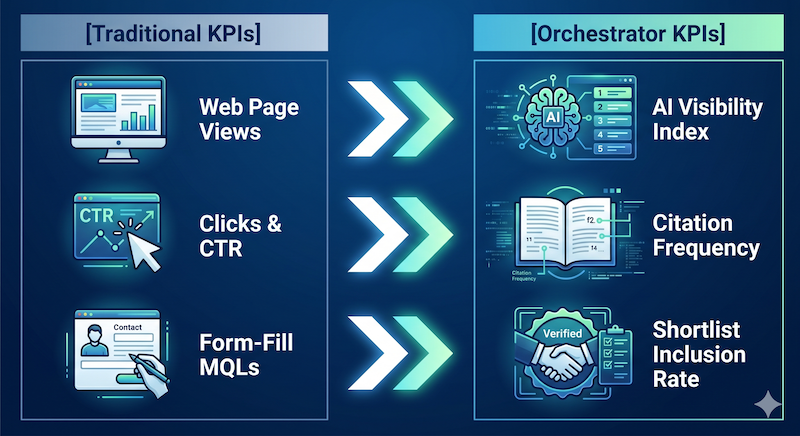
Because the AI Orchestrator operates in a "Zero-Click" digital ecosystem where traditional metrics like page views, web impressions, and form-fill Marketing Qualified Leads (MQLs) are rapidly disappearing, they must manage performance through an entirely new set of Key Performance Indicators.
AI Visibility Index
This metric tracks your brand's overall share of models across major large language models like ChatGPT, Claude, Gemini, and Perplexity. It answers a vital question: when an enterprise buyer prompts an LLM for the "Top 3 solutions" in your niche, how often is your brand presented as the primary recommendation?
Citation Frequency
In the answer economy, a citation is the new backlink. This KPI measures how frequently an AI engine references your proprietary whitepapers, case studies, or structured HubDB data tables as the factual, trusted source backing up its synthesized response.
Shortlist Inclusion Rate
This is the ultimate revenue metric for the modern BDR team.
Recent industry benchmarks from 6sense indicate that roughly 40% of B2B vendor shortlists are now completely AI-influenced.
This tracks the percentage of agent-led corporate procurement queries where your enterprise is verified, selected, and passed along to a human buyer as a qualified fit.
By shifting corporate focus to these advanced, machine-readable metrics, the AI Orchestrator ensures that the marketing and sales teams stop chasing vanity traffic and start building authentic, algorithm-verified authority that captures revenue at the point of inquiry.

Technical AEO Checklist: Is Your Site Machine-Readable?
 If your enterprise revenue team is still prioritizing standard meta-descriptions over deep JSON-LD entity relationships, you are likely losing critical pipeline visibility. In a zero-click ecosystem, the focus has moved past visual layout to programmatic clarity. Is your data structured so that a Large Language Model can seamlessly ingest it, trust it, and cite it as a definitive source? Use this comprehensive, code-level checklist to transform your HubSpot site into a machine-readable knowledge base.
1. The JSON-LD Schema Deep Dive
AI crawlers do not read web pages like humans do; they parse JSON-LD schemas to identify specific entities and map data relationships. While standard metadata tells a bot what a page title is, robust schema builds an authoritative Knowledge Graph. To stand out as a trusted industry source, your code must go beyond basic article markup and implement advanced semantic properties:
-
The sameAs Property: This crucial line of code acts as a digital passport. It explicitly directs AI scrapers to your verified profiles in high-authority databases such as Wikidata, LinkedIn, or official corporate repositories. It tells the AI, "Our brand is the exact same corporate entity as the one listed here," establishing immediate algorithmic trust.
-
FAQPage Schema: This is a powerful layout for AEO. By structuring your content as exact Question-and-Answer pairs within your raw code, you hand-feed the engine a perfect snapshot. This layout makes it incredibly simple for a bot to lift your text directly into a conversational response window.
2. The Rule of 42 (Answer-First Layouts)
AI models operate on computational efficiency. They are programmed to deliver the single best answer with the lowest processing cost. If your page buries a crucial fact under a 500-word introduction or an over-stylized layout, an agent will simply skip it. Enterprise pages must adopt an "Inverted Pyramid" layout, placing the direct answer at the absolute top of the page hierarchy.
Research from SearchEngineJournal indicates that paragraph snippets extracted by AI search engines typically contain between 40 and 60 words, with 42 words sitting as the exact mathematical sweet spot.
In your HubSpot layout modules, ensure your clear H2 headers are followed immediately by a concise, direct paragraph answer within this specific word length. This optimization satisfies initial machine tokens and positions your text perfectly for featured snippets.
3. Multimodal AEO: Optimizing Beyond Text
Modern AI engines do not just read text; they possess multimodal capabilities that allow them to "see" and "hear" digital assets. Models like GPT-4o and Gemini heavily analyze images and video components to answer user requests. If your HubSpot portal uses visual assets purely as decoration rather than structured data sources, you miss a massive opportunity.
-
Descriptive Alt-Text: Eliminate generic tags like "man at desk." Instead, provide high-density context: "Enterprise executive using HubSpot Breeze AI prospecting agents to optimize sales pipeline data."
-
Full Media Transcripts: Provide complete transcripts with distinct timestamps for all video assets. This allows an autonomous task bot to "read" your visual content in milliseconds and cite your video as a primary research source. By checking these technical boxes, you ensure your platform speaks the exact language the new gatekeepers require.
-
Voice and Local AEO Integration: Voice queries are inherently conversational and action-oriented. When an enterprise buyer or local consumer asks a smart speaker, "Where is the nearest SOC2-compliant data center?", AI models rely heavily on perfectly synchronized local citations. To capture this high-intent traffic, your HubSpot infrastructure must maintain strict Name, Address, and Phone number (NAP) consistency across your footer, your Google Business Profile, and your structured LocalBusiness JSON-LD schema—complete with precise latitude and longitude coordinates. This absolute geographical certainty ensures that voice assistant reasoning engines recommend your physical locations during localized on-the-go searches.

The 90-Day Transformation Roadmap
 Executing the AI Shift: A Blueprint for Enterprise Readiness
Transitioning a sprawling enterprise digital footprint to an AI-first model can feel like a monumental operational hurdle. Over years of traditional content creation, marketing teams meticulously built "content moats"—hundreds of long-form articles designed to capture organic real estate on outdated search engines. However, as the digital ecosystem moves deeper into the answer economy, those legacy assets often become liabilities.
Today, you are no longer writing purely for human browsers; you are building an authoritative repository for the machine learning models that talk to them. If your old content strategy feels like it is losing its grip on the market, you do not have to scrap your entire library. Instead, enterprise leaders should implement a tactical, 90-day transformation roadmap to turn legacy text into structured, AI-ready powerhouses.
Phase 1 (Days 1–30): The "Answer-First" Audit
You cannot fix an operational bottleneck that you cannot accurately measure. The first month of your digital roadmap is dedicated entirely to asset triage and identification. Traditional search tools track keyword positioning, but a modern technical audit requires an AEO Grader to establish your definitive Share of Model score. This advanced metric tracks exactly how frequently your brand name, core products, or data points are actively cited by reasoning engines.
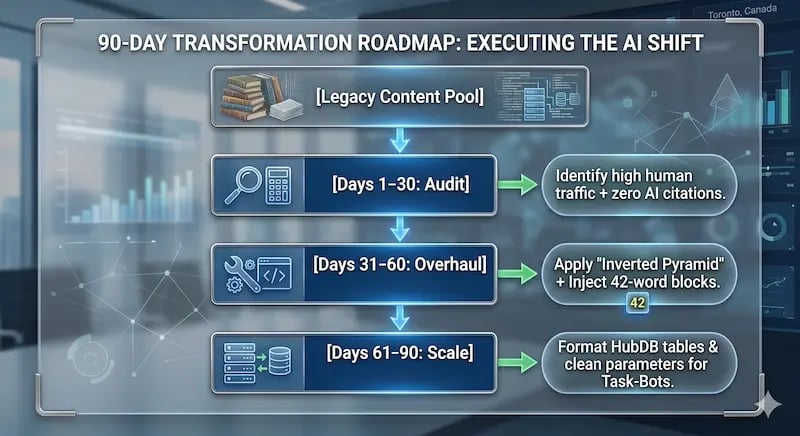
During these first 30 days, your primary objective is to review your highest-traffic, highest-revenue pages. Isolate the assets that capture human clicks but completely fail to register AI citations. These gaps represent your highest immediate ROI. Focus your energy on your top-performing, high-intent transactional pages—such as product comparisons, technical integrations, and implementation guides—to prepare them for systemic code updates.
Phase 2 (Days 31–60): The Machine-Readable Overhaul
Once your target pages are identified, the operational focus shifts directly to structural re-engineering. This phase merges technical AEO requirements with authoritative writing. You must re-architect every page to follow a strict Inverted Pyramid format. Instead of opening an article with broad industry generalizations or flowery introductions, you must place the core answer directly at the top of the text layout.
Inject a concise, 42-word direct answer block immediately following your primary H2 headers. Next, eliminate "SEO fluff"—the long-winded, repetitive prose originally written to game older algorithms by inflating on-page time. To a modern large language model, that filler text acts as digital noise, driving down your data density. Complete this phase by hardcoding an advanced JSON-LD schema into your HubSpot templates, providing the AI with an explicit data map of your business concepts.
Phase 3 (Days 61–90): Optimizing for Agentic Workflows
The final month of your transformation goes beyond simple user prompts, focusing entirely on the autonomous task-bot economy. By this stage, your content is clean, verified, and indexable. Now, you must optimize for agentic workflows where software agents execute end-to-end procurement tasks.
Autonomous agents are programmed to extract hard parameters without human intervention. To support this, you must structure your product specifications, service levels, and operational metrics into clean, programmatic formats. Scrap long paragraphs of text in favor of highly organized data tables and bulleted lists. Software bots prefer tables because they can parse cells and compare metrics in milliseconds. By systematically cleaning your data delivery, you elevate your digital presence from an informative blog to a highly responsive, machine-readable pipeline engine.
Moving Toward an Autonomous Economy
We are moving toward a world where your Ideal Customer Profile (ICP) is not just a human. It is a combination of a human decision-maker and their AI agent. This is the secret to scaling growth and ensuring your revenue operations are solid.
To thrive, you must ask yourself:
- Is my data discoverable?
- Is my value verifiable?
- Is my lead-capture actionable for a machine?
The companies that win will be those with the best technical architecture and the cleanest data. Any competitor can copy a product feature, but no competitor can copy the deep, structured history of your customer relationships stored in a well-governed HubSpot CRM.
The Role of Aspiration Marketing
At Aspiration Marketing, we are technical architects who prioritize systems over slogans. We understand that a CRM is only as good as the processes that power it. Pretty templates won't fix a broken handoff, and creative copy won't clean up a decade of dirty data.
We specialize in this exact 90-day transformation. We help you move from "searching" to "answering" by building the infrastructure for the future of revenue. Whether you need a technical AEO audit, a HubSpot "reset," or a strategy for the "Task-Bot" economy, we ensure your brand is ready for the autonomous economy.
The future of search is not a list of blue links. It is an AI agent saying: "I have analyzed the market, verified the data, and booked a meeting with the best partner for us."
Make sure that partner is you.