
The Answer Engine Optimization Era and the Future of Digital Discovery

Master the shift to Answer Engine Optimization—secure your brand's authority in a zero-click world and become the definitive source cited by AI.

AEO

What is Answer Engine Optimation (AEO)?


Work in progress - check back often.


1.  The ROI of Trust: The Economic Case for Credibility

Many organizations mistakenly view credibility as a "soft" metric or a PR concern. However, in a data-driven inbound strategy, credibility functions as a primary driver of financial performance. When a brand successfully earns trust, it realizes something like a "Trust Dividend"—a measurable acceleration of business processes and a reduction in costs. Conversely, brands lacking credibility pay a "Trust Tax", where every transaction is slowed by skepticism, and every lead costs more to convert.

The Financial Impact of High Credibility

The return on investment for brand trust manifests in four key areas of the balance sheet:

A. Shortening the Sales Cycle and Velocity

Credibility acts as a shortcut in the human brain. In the B2B sector, the typical buyer's journey involves multiple stakeholders and a complex evaluation process. This "interrogation phase" exists primarily to mitigate risk.

  • The Acceleration Factor: When a prospect enters your funnel already trusting your expertise, the time spent in the evaluation phase is drastically reduced. High-trust brands report sales cycles that are up to 40% shorter than their low-trust counterparts.

  • Reduced Friction: Trust eliminates the need for endless "proof of concept" trials or excessive legal back-and-forth. If the brand is credible, the buyer assumes the product will perform as promised.

B. Premium Pricing Power and Margin Protection

Price sensitivity is often a symptom of low trust. If a customer doesn't believe your brand is significantly better or more reliable than a competitor, they will default to the lowest price.

  • The "Anxiety Discount": Brands with low credibility must offer deep discounts to convince a buyer to take a risk.

  • The Trust Premium: Research indicates that 95% of consumers are willing to pay more for a brand they trust. Credibility reduces the "anxiety cost" for the buyer, allowing the brand to maintain higher margins even in a competitive or commoditized market.

C. The Referral Engine and Organic Growth

Credibility is the primary driver of the flywheel effect. A credible brand doesn't just acquire a customer; it acquires an advocate.

  • The Stats: 92% of B2B buyers are more likely to purchase after reading a trusted review or peer case study.

  • Lowering CAC: As your credibility grows, your Customer Acquisition Cost (CAC) drops because organic referrals and word-of-mouth begin to do the heavy lifting that paid advertising used to perform.

D. Increased Customer Lifetime Value (LTV)

Trust is the glue of retention. It is far more expensive to acquire a new customer than to keep an existing one.

  • Loyalty as a Default: Customers who trust a brand are 3x more likely to remain loyal over a five-year period. They are also significantly more open to upselling and cross-selling because the "proof of value" has already been established.

The Psychology of "De-Risking" the Purchase

To understand the ROI of trust, we must look at the psychological state of the modern buyer. Every purchase—especially in B2B—is a moment of personal risk for the decision-maker.

  • Professional Stakes: If a B2B buyer chooses a vendor that fails, they risk their professional reputation, their bonus, or even their job.

  • The Safe Choice: Credibility positions your brand as the "safe choice." In the history of enterprise computing, the phrase "Nobody ever got fired for buying IBM" was the ultimate testament to the ROI of brand credibility. It wasn't that IBM was always the cheapest or the fastest; it was the most credible.

Measuring the "Unmeasurable"

How do you track the ROI of a "soft" concept like trust? At Aspiration Marketing, we look at several key data points:

  1. Branded Search Volume: An increase in people searching for your brand name (rather than a generic keyword) is a direct indicator of growing authority.

  2. Conversion Rate by Content Type: Compare the conversion rate of leads who engaged with expertise content (white papers, webinars) versus those who only engaged with promotional content.

  3. Net Promoter Score (NPS): High NPS scores are a trailing indicator of trust and credibility.

  4. Sales Velocity: Measuring the days from "Lead Created" to "Closed-Won" before and after implementing a credibility-focused inbound strategy.

2. Implementing Trust as a Brand Foundation

Building credibility is not a task for the marketing department alone; it is a mandate for the entire organization. It begins with the realization that visibility without trust is a liability. If your marketing reach is high but your credibility is low, you are simply broadcasting your flaws to a larger audience.

Operationalizing Honesty

To build a truly credible brand, organizations must move toward Brand Participation.  This involves actively living out your brand values through measurable actions, rather than merely "purpose-washing" with slogans. This also where consumers move from being passive receivers of advertisements to active contributors in a brand's narrative

Internal Alignment: The "Say/Do" Ratio

The "Say/Do" ratio is the ultimate internal metric for brand credibility.

  • Marketing says: "We are customer-obsessed."

  • Operations does: Makes it nearly impossible to cancel a subscription or reach a human in support.

When the "Do" does not match the "Say," credibility is destroyed instantly. To fix this, leadership must ensure that every department is aligned with the brand's trust-building mission. If transparency is a core value, it must be reflected in your contracts, your refund policies, and your public roadmap.

The Human-to-Human (H2H) Shift

In an era of AI automation, the most "premium" signal a brand can send is humanity. We are seeing a massive shift from B2B (Business-to-Business) to H2H (Human-to-Human) communication.

  • Empathy over Efficiency: Credible brands don't just solve problems; they acknowledge the stress those problems cause the customer.

  • The Voice of the Expert: Instead of "The Company is pleased to announce," use "Our Lead Engineer, Sarah, discovered a way to..." Putting a face and a name to your expertise increases trust by 35% compared to faceless corporate entities.

Content Marketing Blueprint


3. Closing the Gap: Strategies for Building Real Authority

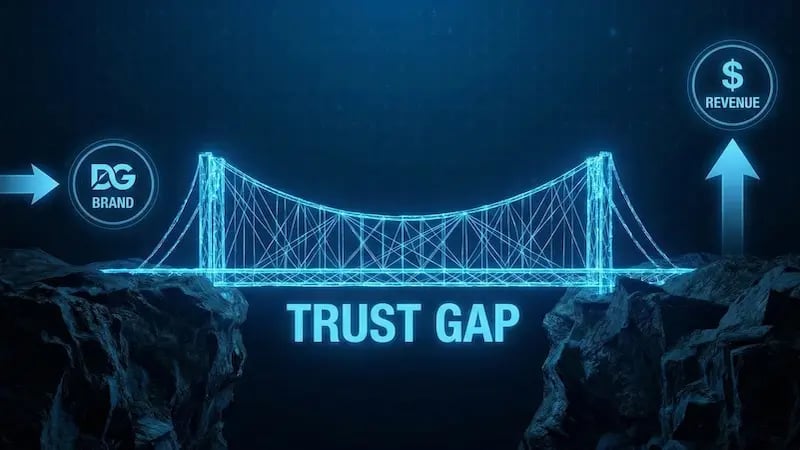
The "Trust Gap" is more than a marketing hurdle; it is a structural failure in the relationship between a brand and its audience. Recent data reveals a jarring disconnect:

While 79% of B2C leaders believe they are trusted by their customers, only 52% of their customers agree.

This 27-point disparity is where sales are lost, and reputations crumble.

To bridge this gap, brands must move beyond superficial "about us" pages and implement a strategy of tactical transparency. This isn't about revealing trade secrets; it is about providing the information your customers need to feel safe making a decision.

The Tactical Transparency Framework

Tactical transparency is the practice of proactively addressing the "uncomfortable" parts of the buyer's journey. When you answer the questions your competitors are afraid to touch, you immediately ascend to the position of a trusted advisor.

A. The "Anti-Sales" Pitch: Admitting Limitations

One of the most powerful ways to build credibility is to tell a prospect when you are not the right fit.

  • The Strategy: Proactively list the types of companies or use cases where your product will fail to deliver maximum value.

  • The Result: This "honesty over the sale" creates a psychological anchor. When you eventually explain why you are the right fit for a different problem, the prospect believes you implicitly because you've already proven you prioritize their success over your commission.

B. Radical Pricing Clarity

Suspicion lives in the shadows of "Contact for Pricing" buttons. In the B2B world, transparency regarding costs is a massive trust signal.

  • The Framework: Even if your solution is highly customized, you can provide "Investment Ranges" or "Typical Project Costs."

  • The ROI: Providing pricing transparency reduces the "perceived risk" of a discovery call. It signals that you are "not playing games" and respect the buyer's time.
    Topics - AEO

C. The "You Asked, We Answered" Content Loop

Every salesperson has a list of "tough questions" they dread. Instead of hiding from them, turn them into your primary content strategy.

  • The Execution: Publish articles titled "Why Our Product Costs More Than [Competitor]" or "Common Failures During Implementation and How We Fix Them."

  • The Psychological Trigger: This addresses the confirmation bias of the skeptic. If they are already looking for reasons to doubt you, seeing you address those doubts head-on disarms their skepticism.

Leveraging Inbound to Bridge the Gap

Inbound marketing is the "natural habitat" of credibility because it is inherently non-interrupted.

  • Educational Authority: By providing 5,000-word guides, technical white papers, and original research, you aren't asking for trust; you are demonstrating why you deserve it.

  • The 80/20 Rule of Content: To close the trust gap, 80% of your content must be dedicated to solving the reader's problem without a sales pitch. The remaining 20% can then bridge the gap to your specific solution. When you lead with value, you create reciprocity, a powerful psychological driver that makes the reader more open to your eventual sales message.

    Learn More About Inbound Marketing

4. Digital Authority and the AI Search Credibility

Today, brand credibility has a technical component that didn't exist a decade ago. We have moved from the era of SEO (Search Engine Optimization) to the era of GEO (Generative Engine Optimization). AI search engines like Gemini and Perplexity do not just look for keywords; they look for entities of trust.

The Evolution of E-E-A-T

Google's Search Quality Rater Guidelines emphasize E-E-A-T: Experience, Expertise, Authoritativeness, and Trustworthiness. However, for AI engines, "Trustworthiness" is the "Center of the Universe." Without trust, the other three components are irrelevant.

A. Experience: The "I" in Credibility

AI can summarize facts, but it cannot (yet) simulate human experience. To build digital authority, your content must move away from generic "how-to" language and toward first-person authority."

  • Tactical Tip: Use case studies, personal anecdotes from your engineers, and direct observations. AI engines prioritize content that proves a human was actually there, doing the work.

B. Authoritativeness: The Ecosystem of Mentions

AI engines determine your authority by looking at the digital neighborhood you inhabit.

  • The Credibility Map: If high-authority sites like industry journals, news outlets, and academic papers link to your research, the AI views you as a node of truth.

  • The Strategy: Focus on digital PR—getting your experts quoted in third-party publications—to build a web of authority that surrounds your main domain.

C. Trustworthiness: Technical and Factual Accuracy

  • Fact-Checking: AI engines are increasingly capable of identifying "hallucinations" or factual errors. If your blog contains outdated statistics, your entire domain's credibility score can be downgraded.

  • Technical Trust: SSL certificates, high site speed (Core Web Vitals), and secure data handling are the "hygiene factors" of digital credibility. If your site is slow or insecure, the AI (and the human user) will flag you as unreliable.

5. Social Media: The Modern Credibility Engine

Social media is no longer just a distribution channel for your blog posts; it is a real-time credibility laboratory. It is often the first place a prospect goes to perform a "proof of life" check on your brand. If your last post was three months ago, or if your comments section is a graveyard of unanswered questions, your credibility is compromised before the prospect even reaches your website.

Topics - AEO

The Power of Storytelling: Retention over Data

While statistics like the fact that high-trust brands report sales cycles up to 40% shorter build the logical case for your expertise, stories build the emotional connection required for trust. Social media is storytelling - it's a narrative about what your brand stands for, how your product is what they're looking for, and who you are as a company.

  • The retention gap: Research indicates that while only 5-10% of raw data is retained by audiences, 65-70% of information is retained when shared through storytelling.

  • Visible Operations (BTS): One of the most effective storytelling techniques for credibility is visible operations. By showing the behind-the-scenes (BTS) of how you solve problems, you demystify your process and reduce the perceived risk for the buyer. Brands that consistently post BTS content report a 41% higher engagement rate and significantly higher trust scores.

The 80/20 Rule of Digital Authority

To maintain authority on social platforms, you must resist the urge to turn your feed into a continuous sales pitch.

  • 80% Value-Add: Educational content, industry trends, and "how-to" guides that solve problems for free.

  • 20% Promotional: Direct calls to action, product updates, or webinar invites. When you lead with value, you build a trust reserve. When you eventually ask for a meeting or a sale, you are drawing from that reserve rather than overdrawing an empty account.

Deep Dive: Employee Advocacy and Executive Thought Leadership

A brand's credibility is the sum of the credibility of its people. In the B2B world, prospects trust a company's employees 3x more than the official corporate brand account. This is the foundation of employee advocacy.

The "Satellite Office" Framework

Every employee with a LinkedIn profile is a "satellite office" for your brand's credibility.

  1. The Expert Voice: When an engineer shares a technical breakthrough, it carries more weight than a marketing professional sharing the same news. It proves that there are real experts "in the trenches."

  2. Executive Presence: Founders and executives must act as the "Chief Credibility Officers." By sharing their perspectives on industry challenges and, crucially, their mistakes, they humanize the organization.

  3. The H2H Shift: Moving from B2B (Business-to-Business) to H2H (Human-to-Human) means allowing your employees to show their personalities. Authenticity is the antidote to the "uncanny valley" of AI-generated corporate content.


6. Tactical Execution: The Credibility Audit

To bridge the Trust Gap, you must first measure it. A credibility audit identifies the points in your customer journey where trust is leaking.

The Five Key Audit Points:

  1. The "First Impression" Audit: Does your website load in under 3 seconds? Does it have an SSL certificate? Are your visuals consistent? (Technical Trust).  

  2. The "Proof of Success" Audit: Are your case studies up to date? Do they include specific, measurable ROI, or are they filled with vague fluff? (Expertise Trust).

  3. The "Say/Do" Audit: Go through your marketing copy and highlight every promise made. Then, interview your customer success team to see if those promises are being kept. (Operational Trust).

  4. The "Accessibility" Audit: How hard is it to find a human to talk to? If a prospect has a question, can they receive an answer within 24 hours? (Relational Trust).

  5. The "Social Proof" Audit: What do third-party sites (G2, Capterra, Google Reviews) say about you? Are you responding to negative reviews with accountability and transparency? (Authoritative Trust).


Topics - AEO


Trust And The Long Game of Growth

Brand credibility is not a "one-and-done" project; it is the long game of business growth. In an era where AI can scale content production to an infinite degree, humans must scale trust. We have reached a point of content Saturation, where the volume of information available to a buyer is overwhelming. In this landscape, the winner is no longer the brand that shouts the loudest, but the brand that is believed the most.

From Visibility to Indispensability

The transition from being a "visible" brand to an "indispensable" one is fueled entirely by your commitment to the credibility framework. Visibility is a commodity—anyone with a credit card can buy an ad. Indispensability, however, is a competitive moat. When you prioritize radical transparency, you aren't just giving away information; you are removing the barriers to the sale. When you empower your employees to speak as individual experts, you aren't just "humanizing" the brand; you are creating a decentralized network of authority that no competitor can easily replicate.

The Compounding Interest of Credibility

Credibility functions much like compound interest. Initially, the efforts—such as publishing in-depth guides, acknowledging limitations, and responding to every comment—may seem insignificant. However, over time, these actions build a trust reserve that pays dividends:

  • The Resilience Factor: When market conditions shift or a product glitch occurs, credible brands are given the benefit of the doubt. Their "Trust Reserve" allows them to weather storms that would sink a less-reputable competitor.

  • The Talent Magnet: High-trust brands don't just attract better clients; they attract better talent. Moving forward, the best experts want to work for organizations where integrity is an operational reality, not just a poster in the breakroom.

  • The "Zero-Waste" Marketing Model: As your authority grows, your marketing becomes more efficient. You no longer have to "convince" prospects of your value; your reputation has already done the heavy lifting before the first discovery call.

The Future: AI-Search and the "Human Signal"

As we look toward the future of search and discovery, the "Human Signal" will become the ultimate differentiator. AI search engines are designed to find the most "helpful" and "reliable" answers. By maintaining a high "Say/Do" ratio—where your operational reality consistently matches your marketing promises—you feed the AI the data it needs to recommend you.

Integrating trust-building as a key facet of brand credibility aligns with Aspiration Marketing's data-driven inbound strategies. Our goal is to ensure that your visibility in AI search engines doesn't just result in a "click," but in a connection. We believe that in a digital world, the most powerful technology is still one that keeps its promises.

By following the strategies outlined in this guide—from the tactical transparency of your pricing to the storytelling of your visible operations—you ensure that your brand stands as a beacon of authority in a skeptical market. The growth path is no longer paved with mere attention; it is paved with the ironclad trust of a well-earned reputation.

Suggested Reading