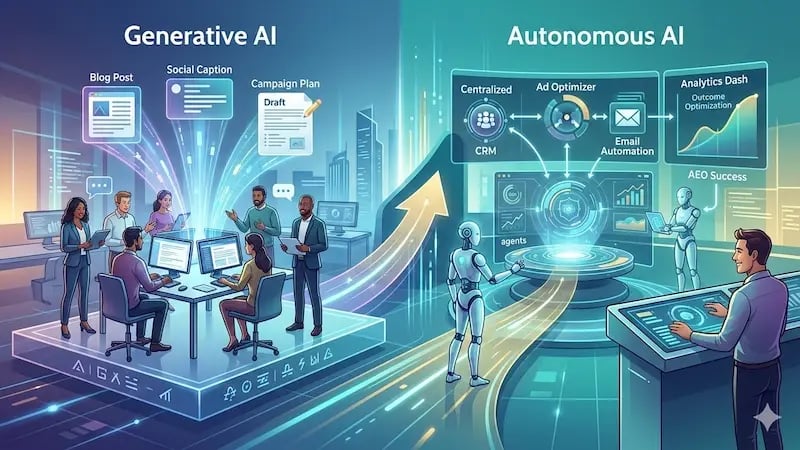
Avez-vous déjà eu l'impression de courir sur un tapis roulant dont la vitesse ne cesse d'augmenter ? Dans le monde du marketing numérique, ce tapis roulant, c'est la production de contenu. Depuis deux ans, l'IA générative est le véritable accélérateur par excellence. Elle nous a permis d'écrire plus vite, de concevoir plus rapidement et de trouver des idées plus facilement. Mais voici une question qui pourrait bien vous faire réfléchir :
Si tout le monde bénéficie du même coup de pouce, qui en tire réellement un avantage ?
La vérité, c'est que se contenter de créer du contenu ne suffit plus à s'imposer. C'est le minimum requis. C'est le seuil d'entrée. Si vous voulez atteindre les limites du possible dans le monde des affaires moderne, vous devez aller au-delà de la simple production de mots. Vous devez vous tourner vers l'autonomie. Nous assistons actuellement à une évolution majeure de l'IA dans le marketing, qui passe des systèmes génératifs aux systèmes autonomes. Si vous n’avez pas encore pris le train en marche, vous êtes déjà à la traîne.
Si l'on se tourne vers l'avenir, le marché mondial du marketing basé sur l’IA devrait atteindre le chiffre vertigineux de 107 milliards de dollars d'ici 2028. Cette croissance ne provient pas de personnes rédigeant de meilleures consignes ; elle provient d'entreprises développant des moteurs autonomes.
1re partie : Le passage de la génération à l'autonomie
L’ère générative : pourquoi le contenu constitue désormais le « socle »
Lorsque ChatGPT a fait son apparition, les barrières à l'entrée pour la création de contenu ont disparu.
Selon le rapport « State of AI » de HubSpot, environ 75 % des professionnels du marketing utilisent désormais des outils d’IA générative pour les aider dans leurs tâches quotidiennes.
Cette adoption généralisée a donné naissance à une nouvelle réalité : le contenu est partout. L'IA générative excelle dans la rédaction d'articles de blog, la création de légendes pour les réseaux sociaux et la génération d'images. Cependant, ce n'est que le premier niveau : le hall d'entrée d'un super-gratte-ciel.
Voyez les choses ainsi : l'IA générative est une machine à écrire ultra-puissante. Elle a besoin d'un humain pour s'asseoir, saisir une consigne, vérifier le résultat et le publier manuellement sur un site web ou une plateforme sociale. Le professionnel du marketing continue de faire le travail de fond : il rédige la consigne, puis évalue la réponse. Ensuite, il révise la consigne et recommence. Puis encore. Jusqu’à ce que l'IA trouve la bonne réponse.
La limite est claire : il s'agit toujours d'un processus manuel. Il nécessite une intervention humaine à chaque étape.
Une étude de Salesforce a révélé que 43 % des spécialistes du marketing ont encore du mal à gérer l’effort manuel nécessaire à la gestion des campagnes sur différents canaux.
Si vous vous contentez d'utiliser l'IA pour rédiger davantage d'e-mails que vous devez ensuite envoyer et suivre manuellement, vous n'avez pas encore tiré pleinement parti de son potentiel.
Vers l'autonomie: atteindre le plafond
Si la création de contenu représente le plancher, mener une campagne réussie avec un minimum d’efforts représente le plafond. C’est là que l’IA et l’autonomie entrent en jeu.
Quelle est la différence ? Alors que l’IA générative produit un résultat à partir d’une consigne, l’IA autonome poursuit un objectif. Au lieu de demander à une IA d' « écrire un article de blog sur le référencement naturel », vous pourriez demander à un système autonome d' « augmenter le trafic organique de 15 % au cours du prochain trimestre ».
Le système autonome ne se contente pas d’écrire ; il recherche des mots-clés, analyse la concurrence, publie le contenu, surveille les performances, puis l'ajuste s'il n'atteint pas l’objectif fixé. Il passe du statut d'assistant à celui de collègue numérique. Cela marque le passage du marketing réactif (résoudre les problèmes après coup) au marketing proactif (mettre en place des solutions avant même que vous ne vous connectiez pour prendre votre café du matin).
Mais ce n'est qu'un aperçu de ce que l'IA permet de réaliser dans le domaine du marketing.
 L'essor des agents IA
Nous assistons à cette transition en temps réel avec l'arrivée des « agents ». Par exemple, les agents HubSpot Breeze constituent une avancée majeure. Il ne s'agit pas simplement de chatbots, mais de véritables collaborateurs opérationnels.
-
Agents de contenu : ils ne se contentent pas de rédiger ; ils apprennent le ton de votre marque et identifient les lacunes de votre stratégie actuelle. Ils repèrent les sujets tendance et proposent un calendrier éditorial complet pour combler ces lacunes.
-
Agents du service client : il ne s’agit pas simplement de chatbots rigides, mais d'experts techniques disponibles 24 h/24 et 7 j/7 qui résolvent des problèmes complexes en « lisant » l'intégralité de votre base de connaissances. Ils résolvent les problèmes en temps réel, réduisent le volume de tickets traités par les humains jusqu’à 77 % et s'appuient sur le contexte historique pour savoir exactement quand transférer une conversation à forte valeur ajoutée à un conseiller en direct.
-
Agents de prospection : ils se chargent du travail de fond du développement commercial. Ils effectuent des recherches sur un prospect, trouvent une « accroche » pertinente et rédigent un e-mail de prise de contact personnalisé sans que vous ayez à cliquer sur le moindre bouton.
-
Agents chargés des réseaux sociaux : ils surveillent les conversations en temps réel. Ils ne se contentent pas de programmer des publications ; ils répondent aux mentions, signalent les problèmes liés au service client et adaptent leur ton en fonction du sentiment de la communauté.
AEO et le paysage marketing
Avec l’adoption généralisée de l’IA, la manière dont les gens trouvent des informations évolue. Nous nous éloignons du référencement naturel traditionnel (SEO) pour nous orienter vers l'optimisation des moteurs de réponse (AEO). Il ne s'agit plus de chercher où trouver la réponse, mais de rechercher la réponse elle-même.
En quoi cela est-il important pour l'IA autonome ? Parce que les moteurs de recherche basés sur l’IA ne se contentent plus de fournir une liste de liens, mais fournissent désormais des réponses directes.
Cette évolution marque le passage du modèle des « dix liens bleus » à une réponse unique et synthétique. Que ce soit via ChatGPT, les « AI Overviews » de Google ou des agents d’IA spécialisés, la manière dont les utilisateurs découvrent votre marque a changé. Si votre contenu n’est pas conçu pour être lu par une machine ni à voix haute par un utilisateur, vous êtes pratiquement invisible.
Gartner prévoit que d’ici la fin de l’année, le volume des recherches sur les moteurs de recherche traditionnels baissera de 25 %, les utilisateurs se tournant vers les chatbots IA pour obtenir des réponses.
Les systèmes autonomes vous aident à opérer cette transition vers l’AEO en :
-
Analyse de l’intention : comprendre le « pourquoi » qui se cache derrière la question d’un utilisateur.
-
Structurer les données : en appliquant automatiquement un balisage de schéma afin que les moteurs de réponse puissent mieux « lire » votre site.
-
Mise à jour en temps réel : actualiser les statistiques obsolètes de vos articles de blog afin que vous restiez la source la plus « à jour » pour l'IA.
L'IA dans le marketing : Breeze Agents, Loop Marketing et The Flywheel.
Où tout cela nous mène-t-il ? Prendre conscience que l'ère du marketing traditionnel est révolue.
La vérité, c'est que l'entonnoir marketing — celui où l’on verse des prospects par le haut en espérant que quelques clients en ressortent par le bas — ne fonctionne plus. Il est linéaire, il présente des fuites et, à l’ère de l’évolution rapide de l'IA, il devient obsolète. Les marques avant-gardistes délaissent ce « seau percé » pour s'orienter vers un cycle autosuffisant : le Flywheel.
Mais même un volant d'inertie a besoin d'un moteur pour continuer à tourner sans effort manuel continu. C'est là que l'IA autonome prend tout son sens. Lorsque vous combinez les agents HubSpot Breeze avec la méthodologie Loop Marketing, vous n’obtenez pas seulement un processus plus rapide ; vous obtenez un volant d'inertie alimenté par l'IA qui prend de l’élan tout seul.
Comprendre le « Loop Marketing » : au-delà de l'entonnoir linéaire
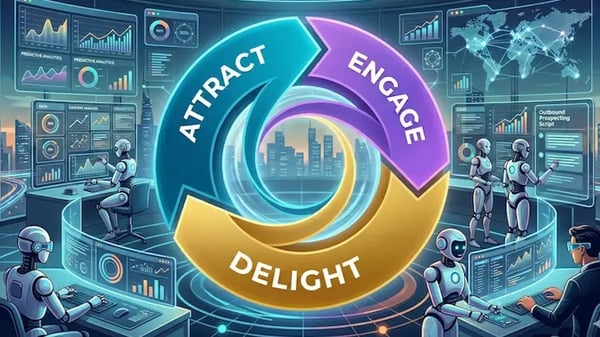 Avant de parler du moteur (l'IA), il faut comprendre la machine (la stratégie). Le « Loop Marketing » s’éloigne de la nature ponctuelle de la génération de prospects traditionnelle. Dans un entonnoir linéaire, la relation se refroidit souvent considérablement après une vente. Dans le « Loop Marketing », chaque interaction avec un client est conçue pour alimenter le système et attirer le client suivant.
Considérez cela comme un cycle continu d'attraction, d'engagement et de satisfaction. La boucle se crée lorsque vos clients satisfaits deviennent vos meilleurs ambassadeurs, se chargeant ainsi efficacement de l’« attraction » vers votre place. Il existe toutefois un obstacle majeur : la friction. La friction survient lorsque les données sont cloisonnées ou lorsqu'un client doit attendre 6 heures pour obtenir une réponse.
Pour éliminer ces frictions, vous avez besoin d’une architecture technique permettant un mouvement continu. Selon des rapports sectoriels récents,
près de 70 % des responsables marketing estiment que l’IA agentique va transformer le secteur, en fournissant le lubrifiant indispensable pour maintenir ce volant d’inertie en mouvement.
Phase 1 : Attirer avec précision (contenu et agents sociaux)
C'est généralement au cours de la phase d'attraction que les frictions sont les plus importantes. Les équipes marketing sont souvent prisonnières d'un cycle où « le contenu est une fin en soi ». Un agent de contenu change la donne. Au lieu de partir d'une page blanche, il utilise vos données existantes les plus performantes pour générer des brouillons en adéquation avec le ton de votre marque et vos objectifs de référencement naturel (SEO).
Mais la véritable magie de cette « boucle » opère lorsque vous intégrez l'IA au processus. Imaginez que vous rédigiez une page pilier approfondie. Auparavant, vous auriez passé des heures à transformer cet article unique en dix extraits pour les réseaux sociaux. Avec un agent de réseaux sociaux, cette page-pilier est automatiquement transformée en une campagne multicanale.
Est-ce efficace ?
Oui. Les premiers utilisateurs des outils basés sur l’IA de HubSpot indiquent avoir enregistré une augmentation de 129 % du nombre de prospects et conclu 36 % de contrats en plus après seulement un an d’utilisation
Phase 2 : Interaction à grande échelle (prospection et agents de données)
Une fois que vous avez attiré un public, vous devez susciter son engagement. C’est là qu’un agent de prospection met fin à l’ère des MQL en prédisant la croissance du pipeline plutôt que de se contenter de compter les clics. Il analyse le profil LinkedIn d'un prospect, examine ses interactions sur le site web et rédige un message de prise de contact hyper-personnalisé.
Pour qu'un agent de prospection soit efficace, il a besoin de données de qualité. Un agent de données s’exécute en arrière-plan de votre CRM, en nettoyant et en enrichissant votre base de données en temps réel. Lorsque vos données sont propres, l'engagement semble plus humain et moins automatisé.
L’impact : on estime que les agents IA permettront de réduire le travail manuel et les coûts opérationnels d’au moins 30 % d’ici fin 2025.
Phase 3 : Satisfaire et fidéliser (l'agent client)
Dans le « Loop Marketing », le service client est un moteur de croissance. Un client qui bénéficie d'une expérience fluide et rapide est bien plus susceptible de recommander votre entreprise. Le recours à un agent client offre un outil disponible 24 h/24 et 7 j/7 qui exploite l’intégralité de votre base de connaissances et de l’historique des tickets pour fournir de véritables solutions, et non seulement des liens.
Réfléchissez à ceci :
Kaplan Early Learning a mis en place Breeze Customer Agent de HubSpot. Grâce à cet outil, l’entreprise a traité 37 % des 1 800 demandes de chat sans aucune intervention humaine.
Cela permet à votre équipe d'assistance humaine de se concentrer sur les problèmes complexes qui nécessitent de l'empathie et une approche créative pour trouver des solutions.
L'essor de l'orchestrateur IA
Les rôles évoluent. Nous assistons à l'essor de l'orchestrateur d'IA. Son rôle n'est pas d'effectuer le travail, mais de s'assurer que ce « travail » s’aligne sur la stratégie globale de Loop Marketing :
-
Le service marketing utilise l'agent de contenu pour attirer des prospects.
-
Le service commercial utilise l'agent de prospection pour interagir avec ces prospects.
-
Le service client utilise l’« agent client » pour satisfaire ces prospects une fois qu’ils sont devenus clients.
-
RevOps utilise l’« agent de données » pour s'assurer que tout le monde dispose d'une vision commune et précise de la situation.
Pourquoi l’« autonomie » est la seule voie à suivre
Le volume de données et la rapidité des attentes des clients ont dépassé les capacités humaines. Si un prospect visite votre site à 2 h du matin, il attend une réponse immédiate. Si vous avez 10 000 prospects, votre équipe commerciale ne peut pas les examiner manuellement un par un.
Les agents IA autonomes sont le seul moyen de conserver une dimension humaine à l’échelle d'une machine. En intégrant les agents Breeze à votre cadre de Loop Marketing, vous construisez une entreprise qui ne dort jamais, n'oublie jamais de faire un suivi et ne laisse jamais passer un prospect. Cela vous fait passer d’un état de pression constante à un état dynamique.
2e partie : Jeter les bases d'une IA privée
Dans le marketing B2B, tout le monde parle d’IA et de GPT, et de la manière dont ces technologies sont utilisées pour dynamiser les activités. On en entend parler à chaque réunion et on le voit dans chaque fil d’actualité LinkedIn. Mais pour les dirigeants d’entreprise, un énorme point d’interrogation plane toujours sur cette technologie :
Nos données sont-elles réellement en sécurité ?
C’est une question légitime. La plupart d’entre nous ont déjà testé des outils d’IA publics, mais une crainte persiste : confier des secrets d’entreprise à un cloud public reviendrait à crier ses secrets commerciaux sur une place publique bondée. C’est là que le passage aux modèles d’IA B2B privés change la donne.
Pour développer un moteur d’IA hautement performant, trois piliers sont indispensables :
-
Une base de connaissances sécurisée (votre manuel).
-
Une source unique de vérité : votre système nerveux.
-
Des données propres (votre carburant haut de gamme).
Le déficit de confiance envers l'IA dans le B2B : pourquoi la confidentialité est la nouvelle priorité
Pourquoi tant d'entreprises restent-elles encore sur la touche ? Ce n'est pas parce qu'elles n'en perçoivent pas la valeur. C'est à cause du manque de confiance. Selon des données récentes d'IBM,
39 % des professionnels du marketing ne savent toujours pas comment utiliser l'IA générative en toute sécurité sans compromettre l'intégrité des données.
Pour une entreprise B2B, votre documentation est votre recette secrète. Si ces données fuient vers un grand modèle linguistique (LLM) public, vous perdez votre avantage concurrentiel. De plus, les enjeux financiers sont colossaux.
Le coût moyen d'une fuite de données a grimpé à 4,44 millions de dollars en 2025.
C'est pourquoi le « Shadow AI » — lorsque les employés utilisent des comptes d'IA personnels — représente un risque considérable. Pour aller de l'avant, les entreprises ont besoin d'une IA qui ne comprenne que leur activité. Une IA qui ait étudié les nuances spécifiques de vos produits, le ton unique de votre marque et l'historique de vos interactions avec les clients.
En entraînant ces modèles sur votre base de connaissances HubSpot, vous ne vous contentez pas d'utiliser l'IA: vous construisez un cerveau numérique sécurisé et privé pour votre entreprise.

1. Pourquoi votre base de connaissances HubSpot est une mine d'or
Si vous souhaitez entraîner une IA hautement performante, vous avez besoin d'un manuel de qualité. La plupart des entreprises disposent de données dispersées dans des fichiers PDF et sur des canaux Slack. Cependant, si vous utilisez HubSpot, vous disposez probablement déjà d'une source d'information structurée et validée : votre base de connaissances HubSpot.
Votre base de connaissances est le terrain d'entraînement idéal, car elle est déjà vérifiée et structurée. En utilisant votre propre documentation comme source principale, vous résolvez le principal problème de l'IA: les « hallucinations ». Une IA générale pourrait inventer une politique de remboursement ; une IA privée entraînée sur votre base de connaissances HubSpot se contentera de citer votre politique réelle.
Chiffre clé : les entreprises qui utilisent une gestion des connaissances basée sur l’IA ont constaté une réduction de 85 % du temps passé par leurs collaborateurs à rechercher des informations.
Le principe : la génération augmentée par la recherche (RAG)
Ce processus s'appuie principalement sur une méthode appelée « génération augmentée par la recherche » (RAG). Considérez le RAG comme un « examen à livre ouvert » pour l'IA. Au lieu de se fier à son apprentissage initial, l'IA reçoit l'instruction de consulter d’abord votre base de connaissances HubSpot. Lorsqu'un client pose une question, l'IA effectue une recherche dans votre base de données privée, trouve l'article pertinent, puis utilise ses compétences linguistiques pour en résumer la réponse.
Les taux de précision des réponses fournies par le personnel et les clients peuvent atteindre 93 % lorsque l’IA est limitée à une base de connaissances interne spécifique.
Cela transforme un chatbot en un outil professionnel fiable.
2. Mise en place d'une source unique de vérité (SSOT)
 L'intelligence d'une IA dépend de la qualité des données qu'elle exploite. Pour la plupart des entreprises B2B, le principal obstacle n'est pas l'IA elle-même, mais la « dette de données » qui s'accumule dans leur CRM. Si votre CRM est un véritable fouillis de doublons et de liens rompus, votre IA ne fonctionnera pas correctement.
La plupart des entreprises ne disposent pas d’une source unique de vérité. Elles n’en ont que des fragments. Le marketing a sa version des faits. Les ventes en ont une autre. Le service de réussite client en a une troisième. Ce « bruit » est la principale raison pour laquelle les modèles d’IA fournissent des informations commerciales non pertinentes.
Pensez à votre base de données actuelle. Combien de contacts en double contient-elle ? Combien de notes commerciales se résument à «bon entretien » ? Pour un humain, cette note est vague. Pour une IA, elle est inutile. Lorsqu’une IA tente de prédire quelle opportunité aboutira, mais qu’elle manque de données claires, elle se livre à une supposition. Dans l'univers des grands modèles linguistiques (LLM), une supposition équivaut à une hallucination. Une hallucination qui coûte cher.
Le coût est bien réel. Selon Gartner,
une mauvaise qualité des données coûte en moyenne 12,9 millions de dollars par an aux entreprises.
Vous ne pouvez pas vous permettre de vous entraîner sur une erreur de 12 millions de dollars avec un modèle privé coûteux. Vous devez donc construire le système nerveux de votre IA.
Une « source unique de vérité » (SSOT) est un référentiel centralisé et validé qui met les données au format requis pour leur ingestion par les machines. Pour rendre vos données lisibles par les machines, nous utilisons un concept appelé « intégration sémantique par triplets ». Celui-ci repose sur une structure Sujet -> Verbe -> Objet.
Cela aide l'IA à construire un graphe de connaissances, une méthode avancée d’organisation de l’information.
Exemples de triplets sémantiques pour votre CRM :
Sujet |
Verbe (relation) |
Objet |
Pourquoi c'est important pour l'IA |
|---|---|---|---|
Des données propres |
alimentent |
LLM privés |
Définit la source de l’intelligence. |
Propriétés standardisées |
éliminent |
les hallucinations de l'IA |
Crée des règles logiques pour éviter les erreurs. |
HubSpot |
sert de |
base de données pour l'IA |
Établit la source faisant autorité. |
Lorsque vos données suivent cette logique, l’IA n’a pas besoin de deviner. Elle peut voir le lien direct entre un clic marketing et une vente conclue. Mettre cela en place dans HubSpot nécessite un changement de mentalité : vous ne vous contentez plus de « stocker » des données ; vous les « organisez » pour qu’un modèle de langage de grande envergure (LLM) puisse les lire.
Cela s'effectue de manière très précise :
-
Vérifiez la taxonomie de vos données — vous devez disposer d’une source unique de vérité pour chaque champ. Standardisez vos champs à l'aide de menus déroulants et d'une nomenclature cohérente. Éliminez les champs de texte libre lorsqu’une case à cocher serait plus appropriée.
- Utilisez des règles de validation des données — HubSpot vous permet de créer des règles pour la saisie des données. Utilisez-les. S’il manque un chiffre dans un numéro de téléphone, ne laissez pas l’enregistrement être sauvegardé. Si une transaction est déplacée vers le statut « Conclue avec gain » sans motif de gain, bloquez le déplacement. Ces règles agissent comme des garde-fous pour votre ensemble de données d'entraînement d’IA.
- La puissance des objets personnalisés - Les objets standard (Contacts, Entreprises, Opportunités) sont très utiles. Mais pour qu’une IA privée comprenne réellement votre activité, vous pourriez avoir besoin d’objets personnalisés. Si vous vendez des abonnements, créez un objet « Abonnement ». Associez-le clairement à l’entreprise. Cela crée une carte que l’IA peut suivre pour prédire le taux de désabonnement.
On considère souvent l'IA comme un cerveau, mais elle s'apparente davantage à un moteur à grande vitesse. Elle a besoin d’un carburant à indice d'octane élevé. Aujourd'hui, ce carburant, ce sont les données structurées. Dans la mesure du possible, structurez vos données à l'avance à partir de transcriptions d'appels commerciaux, de fiches d'entreprise, etc. Cela rend les données exploitables par un modèle de langage de grande envergure (LLM). Lorsque votre IA privée analyse la base de données HubSpot, elle peut rapidement identifier des tendances au sein de milliers de clients. C'est ainsi que vous prédisez avec précision les opportunités de vente incitative. Vous ne vous concentrez pas uniquement sur un seul client ; vous examinez l’historique lisible par machine de l’ensemble de vos clients.
Une liste de contrôle technique pour des « données prêtes pour l'IA»
Si vous souhaitez positionner votre entreprise comme un pionnier de l’IA axée sur les données, vous devez cocher ces cases dès aujourd'hui. Voici votre liste de valeurs « zéro clic ».
-
Schéma de contacts unifié : toutes les fiches de contacts respectent les mêmes conventions de nommage et de propriétés.
-
Déduplication automatisée : un workflow est en place pour fusionner les doublons avant qu'ils n'atteignent l'IA.
-
Formatage conforme aux normes ISO : les dates, les devises et les codes pays sont normalisés (par exemple, en utilisant la norme ISO 3166 pour les pays).
-
Lien obligatoire : aucun enregistrement orphelin. Chaque contact doit être associé à une entreprise. Chaque entreprise doit être associée à une transaction.
-
Balises de propriétés pour l'IA : les propriétés sont balisées comme « données d'entraînement » ou « métadonnées » afin d'aider l'IA à classer les informations.
3. Résoudre définitivement la crise des « données erronées »
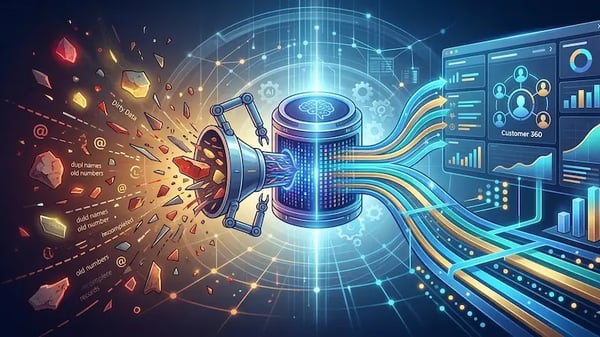 Dans quelle mesure pouvez-vous réellement vous fier à votre CRM à l'heure actuelle ? Nous avons déjà mentionné que les données de mauvaise qualité constituent un problème très coûteux.
Pendant des années, la solution au problème des données erronées reposait sur le travail manuel. Nous embauchions des stagiaires ou confions à des collaborateurs juniors la tâche de « nettoyer la liste ». Mais dans un environnement moderne à forte croissance, les humains ne peuvent tout simplement pas suivre le rythme. La vitesse à laquelle évoluent les affaires a dépassé celle d’un tableur.
Le volume de données que nous gérons aujourd’hui — des visites sur le site web et des données d’intention aux interactions sur les réseaux sociaux et à l'utilisation des produits — est trop vaste. Le temps qu’une personne nettoie manuellement un ensemble de données, de nouvelles données « erronées » ont déjà envahi le système. Cela crée un « retard humain » qui maintient votre équipe perpétuellement à la traîne.
Les statistiques montrent que les services commerciaux et marketing perdent jusqu’à 32 % de leur temps à gérer des problèmes de qualité des données au lieu de se concentrer sur la croissance réelle.
C’est pourquoi il est si avantageux d'utiliser l’IA pour garantir que votre base de connaissances soit une source unique de vérité.
Dans le cadre du RevOps, les données sont le moteur. Notez que,
les données B2B se déprécient à un rythme alarmant d’environ 30 % par an.
Les personnes changent d'emploi, les entreprises fusionnent, et la détérioration des adresses e-mail atteint des pics allant jusqu'à :
3,6 % en un seul mois pendant les périodes de volatilité.
Si l’on tient compte de la complexité des piles technologiques modernes — qui intègrent HubSpot, Salesforce, ZoomInfo et divers outils de vente basés sur l'IA —, le risque de friction des données augmente de manière exponentielle. Vous avez besoin d’une solution qui fonctionne à la vitesse du cloud et comprend le contexte de votre entreprise.
L'IA à la rescousse : automatiser le nettoyage
L'intelligence artificielle agit comme un gardien de votre CRM 24 h/24 et 7 j/7 grâce à :
-
La correspondance approximative : elle reconnaît que « IBM » et « International Business Machines » désignent la même entité afin d’éviter les contacts en double.
-
Enrichissement en temps réel : elle complète automatiquement les intitulés de poste et la taille des entreprises dès qu’un prospect saisit une adresse e-mail.
-
Nettoyage prédictif : signaler les e-mails invalides provenant d’une source de prospects spécifique avant qu’ils ne se propagent.
- Sécurité, conformité et atténuation des risques : des données propres sont plus sûres.
En effet, les organisations qui utilisent l'IA et l'automatisation dans leurs processus de traitement des données ont constaté
une réduction de 80 jours de la durée de leur cycle de fuite de données, ainsi qu’ une baisse des coûts de 1,9 million de dollars grâce à une meilleure visibilité.
Lorsque vous savez exactement quelles données vous possédez et où elles se trouvent, vous réduisez considérablement votre profil de risque. Cela facilite grandement la mise en conformité avec le RGPD et le CCPA, car vous n’avez plus à courir après des fantômes dans votre base de données.
Stratégie : se préparer à la transition vers l'IA
Vous ne pouvez pas simplement appuyer sur un bouton et vous attendre à la perfection. Pour passer de l'IA générative au marketing autonome, suivez cette feuille de route :
-
L'audit de contenu : supprimez les anciens articles et mettez à jour les grilles tarifaires. L'IA imitera ce qu'elle lit, alors fournissez-lui votre meilleur manuel.
-
Taxonomie des données : éliminez les champs de « texte libre » lorsqu'une case à cocher serait plus appropriée. Si vous disposez de cinq champs distincts pour le « titre du poste », votre IA risque de s'y perdre.
-
Intervention humaine : nommez un « orchestrateur d’IA ». Cette personne surveille les performances, vérifie s'il y a des « dérives » dans la qualité des réponses et s'assure que la machine reste fidèle à la mission de la marque.
D'ici la fin de cette année,
81 % des entreprises devraient utiliser des systèmes CRM basés sur l’IA pour rester compétitives.
Celles qui ne parviendront pas à automatiser le nettoyage de leurs données seront submergées par le poids de leurs propres bases de données « sales ».
En mettant l'accent sur la sécurité, la précision et le contexte, vous allez au-delà du simple « engouement » pour l'IA. Vous réduisez le volume de tickets, raccourcissez les cycles de vente et, surtout, protégez vos données confidentielles. Vous posez ainsi les bases d'une entreprise plus rapide, plus intelligente et plus rentable.
3e partie : Stratégie de mise à l'échelle avec des GPT personnalisés, orchestration et action
À ce stade, vous savez quels outils et agents sont disponibles et comment utiliser votre base de connaissances et vos données métier pour bâtir des fondations solides. On peut considérer qu’il s’agit là des étapes de « prise de conscience » et de « réflexion » de votre parcours vers la maîtrise de l’IA. Vient maintenant le moment de la « décision »: comment transformer cette infrastructure en un moteur hautement performant capable de faire évoluer l’intelligence de votre marque ?
Pour atteindre le summum du marketing autonome, vous devez aller au-delà des outils génériques et de la simple automatisation. Vous devez plutôt entrer dans l’ère de l’orchestration et de la création.
1. Au-delà du bot : créer des GPT personnalisés à partir de vos données
La rapidité n’est plus un luxe, c’est une nécessité.
Des études montrent que 61 % des nouveaux acheteurs préfèrent une réponse plus rapide générée par l’IA plutôt que d’attendre qu’un humain réponde à leur demande.
Cependant, une IA générique s’apparente à un stagiaire brillant qui n’aurait pas lu le manuel de votre entreprise. Pour remédier à cela, les dirigeants développent des GPT personnalisés, entraînés sur leur base de connaissances HubSpot spécifique.
L'architecture technique d’un GPT personnalisé
La création d'un GPT personnalisé vous fait passer d’une bibliothèque de documents « statique » à une ressource conversationnelle « active ». Le processus implique :
-
La méthode manuelle ou via l’API : pour les petits ensembles de données, l’exportation manuelle des articles HubSpot vers des fichiers Markdown est la solution la plus adaptée.À l’échelle de l’entreprise, l’utilisation de l’API HubSpot permet de créer un ensemble de données « vivant » : ainsi, lorsqu’un éditeur humain corrige une faute de frappe dans le CRM, le « cerveau » de l’IA se met instantanément à jour.
-
Configuration des personas : c’est à ce stade que vous définissez les limites. Une instruction destinée à un assistant technique doit être précise : « Utilise uniquement les fichiers de la base de connaissances fournis. Si une question n’est pas traitée, ne fais pas de supposition ; suggère de contacter le support. »
-
Actions avancées : c’est le passage d’un bot qui lit à un bot qui agit. Grâce à des connexions via l’API (Actions), votre GPT peut interroger HubSpot en toute sécurité pour fournir le statut d’un ticket d’assistance en temps réel ou vérifier le niveau d’abonnement d’un utilisateur.
Le retour sur investissement de la personnalisation :
-
Précision : les systèmes basés sur la technologie RAG réduisent les « hallucinations » de l'IA jusqu’à 50 %.
-
Efficacité : le volume de tickets traités par des humains peut diminuer jusqu’à 77 %.
2. L'intervention humaine (Human-in-the-Loop) : pourquoi l'IA a besoin d'un superviseur
 Si l’IA est capable de produire des milliers de mots en quelques secondes, pourquoi est-il de plus en plus difficile de trouver des informations auxquelles nous faisons réellement confiance ? La réponse réside dans le « Human-in-the-Loop » (HITL). De cette manière, vous pouvez garantir à la fois la précision technique et l'esprit de la marque.
Ce rôle ne se limite pas à corriger des fautes de frappe ou à déplacer des virgules. Aujourd'hui, le rédacteur HITL fait office d'expert technique (SME), de garde-fou stratégique et d'architecte de l'IA. Il constitue le pont indispensable qui empêche les systèmes automatisés de s'enliser dans une spirale de bruit générique et inutile.
Un contenu issu uniquement de l’IA relève de la consanguinité numérique. Sans un « Human-in-the-Loop » pour y insuffler une réalité nouvelle, votre marque n’est qu’une hallucination d’une hallucination.
Sans intervention humaine, une IA entraînée sur du contenu généré par l’IA finit par perdre sa capacité à représenter fidèlement la réalité.
L'essor de l'orchestrateur d'IA
En 2026, votre meilleur rédacteur pourrait bien être un ingénieur chevronné. L’IA peut imiter un style, mais elle ne peut pas simuler une expertise technique approfondie. Selon un rapport du CMI de 2024,
72 % des spécialistes du marketing de contenu les plus performants ont recours à un processus piloté par des humains pour garantir la qualité et la cohérence de la voix de la marque.
Prenons l'exemple d'un article de blog classique destiné à la phase de sensibilisation. Son objectif est d'informer un client potentiel qui commence tout juste à prendre conscience qu'il est confronté à un problème métier. Si ce client tombe sur un article de blog contenant une erreur technique — peut-être une étape d'intégration obsolète ou une fonctionnalité logicielle mal comprise —, cette confiance est instantanément brisée. Il ne se contentera pas de quitter la page ; il exclura probablement votre marque de son parcours d'achat futur.
Un rédacteur technique s'assure que chaque affirmation formulée par l'IA repose sur des faits avérés. Il vérifie les informations par rapport à une « source unique de vérité », souvent une base de données privée qui contient les connaissances vérifiées de l'entreprise. Sans ce contrôle humain, votre agent de contenu IA ne fait en réalité que deviner en s'appuyant sur Internet public. Comme nous le savons tous, Internet public n'est pas toujours un bastion de rigueur technique.
Voici comment cela fonctionne.
Le workflow HITL :
-
Stratégie et intention : des humains définissent l’« étoile polaire » et les mots-clés.
-
Rédaction par l'IA: les outils produisent une ébauche en quelques secondes.
-
La boucle : des humains vérifient les faits, ajoutent des études de cas concrètes et garantissent un score élevé sur l'indice de lisibilité de Flesch (70+).
-
Éthique et conformité : des humains veillent à ce que l’IA ne fasse pas de promesses irréalistes.
3. Optimisation pour les moteurs de réponse (AEO) : la nouvelle frontière de la recherche
Pour compléter ce que nous avons dit plus haut sur l'AEO, si vous pensez pouvoir remporter la bataille du référencement naturel (SEO) en inondant simplement Internet de textes générés par l'IA, les données suggèrent le contraire. Nous n’approfondirons pas davantage l’AEO sur cette page (car ce sujet mérite une page à part entière), mais il suffit de dire que c’est l’avenir de la découverte. Si vous ne vous y préparez pas, vous serez laissé pour compte.
Tout le monde s'y met. Vous devriez en faire autant. Nous entrons dans ce qu'on appelle un monde « zéro clic » ;
près de 60 % des recherches Google se terminent désormais sans qu’un seul clic ne soit effectué vers un site web.
Les CTR sont obsolètes, et le temps passé sur la page est un indicateur inutile. Ce qui compte désormais, c’est votre part de réponse et la fréquence à laquelle vous êtes mentionné(e) ou cité(e) par le moteur de réponse.
Comment remporter la « part de réponse »
Pour réussir dans un monde régi par l’AEO, votre contenu doit être structuré de manière à ce que les « robots d’indexation » de l’IA puissent l’analyser et le citer facilement.
-
Mise en forme question-réponse : utilisez des titres qui reflètent ce que les utilisateurs saisissent dans la barre de recherche (par exemple, « Comment créer un GPT personnalisé ? »).
-
Données structurées et schéma : utilisez Markdown et le balisage de schéma pour aider les moteurs de réponse à « lire » votre site.
-
La citation, nouveau backlink : dans l'univers des AEO, être cité comme source factuelle par un LLM constitue le signal d'autorité ultime.
-
Optimisation pour les grands modèles linguistiques (LLMO) : veillez à ce que l’« empreinte numérique » de votre marque soit suffisamment crédible pour que des assistants IA tels que Perplexity ou Gemini vous recommandent plutôt qu'un concurrent.
4. Finies les approximations : budgétisation prédictive et cartographie du parcours client
Dans un paysage numérique où les comportements évoluent d’heure en heure, se baser sur les données du mois dernier revient à conduire en ne regardant que le rétroviseur.
Nous examinons ce qui s'est passé le mois dernier, le trimestre dernier ou l'année dernière, et nous essayons de projeter ces résultats dans un avenir de plus en plus volatile. Mais dans un paysage numérique où le comportement des consommateurs évolue d'heure en heure, c'est la recette de l'inefficacité.
Allocation budgétaire prédictive
 C'est là que l'allocation budgétaire prédictive change la donne. En tirant parti de la puissance de l'IA dans la planification du budget marketing, les entreprises s’éloignent des « meilleures estimations » pour s'orienter vers la certitude mathématique. Imaginez pouvoir prévoir quels canaux marketing généreront le meilleur retour sur investissement avant même de dépenser un seul dollar.
Avant d’aller plus loin, il faut comprendre le changement fondamental que l’IA a apporté à la stratégie financière. La budgétisation traditionnelle est statique. Vous fixez une limite, vous la dépensez, puis vous analysez les dégâts. La budgétisation pilotée par l’IA est dynamique. Elle traite votre budget comme un organisme vivant qui réagit aux données du marché en temps réel.
Pourquoi l’IA est-elle bien plus performante dans ce domaine qu’un humain muni d’un tableur ? Cela tient à trois facteurs :
-
Traitement ultra-rapide des données : un spécialiste du marketing humain peut suivre simultanément une douzaine de variables. L’IA peut en suivre des milliers, depuis l’évolution des taux de CPC (coût par clic) selon les régions du monde jusqu'aux variations infimes dans la manière dont un groupe démographique spécifique interagit avec vos livres blancs.
-
Reconnaissance impartiale des tendances : les humains ont des préférences de canal. Nous avons tendance à privilégier les plateformes que nous apprécions ou celles qui ont fait leurs preuves. L'IA n'a pas d'ego; elle ne s'intéresse qu'au parcours de données menant à une conversion.
-
Capacités de simulation : l’IA moderne peut effectuer des simulations de Monte Carlo — des milliers de scénarios hypothétiques — afin de prédire le résultat le plus probable d'une dépense donnée.
L’impact de cette évolution est mesurable.
Selon un rapport de Think With Google, les spécialistes du marketing qui utilisent l’analyse prédictive et des stratégies basées sur les données constatent en moyenne une augmentation de 30 % de l’efficacité marketing et une hausse de 10 % des ventes.
Cartographier le « moment de vérité »
Le parcours client moderne est un enchevêtrement de défilements sur les réseaux sociaux, de recherches tardives sur Google et de conversations rapides avec des bots d'IA. Si vous essayez encore de cartographier ce parcours à l'aide de feuilles de calcul statiques et d’intuitions, c’est comme si vous vous aventuriez dans une forêt tropicale numérique avec une carte papier datant de 1995.
La grande question demeure donc : l'IA peut-elle réellement prédire ce que votre client va faire ensuite ? La réponse est un « oui » retentissant, mais cela nécessite de changer de perspective. Nous devons passer de l’analyse de ce que les clients ont fait à la prédiction de ce qu’ils vont faire. C’est là le cœur de la cartographie du parcours client pilotée par l’IA.
La cartographie traditionnelle du parcours client est rétrospective. Elle vous indique où les gens sont allés après leur départ. L'utilisation de l'IA dans le marketing change la donne en permettant un traitement en temps réel. Au lieu d’une carte statique, considérez l’IA comme un GPS en temps réel qui se recalibre à chaque changement de direction du client. Un client peut voir une publicité sur Instagram, lire un avis sur un site tiers, demander une comparaison à un outil d’IA générative, puis finalement se rendre sur votre site web — pour le quitter et y revenir trois semaines plus tard via un lien direct.
Une IA peut y parvenir de plusieurs façons :
-
Évaluation de l’intention : l’IA distingue un « clic par curiosité » d’un « signal d’achat » (par exemple, consulter la page des tarifs plutôt que de comparer des fonctionnalités spécifiques).
-
Apprentissage automatique : les systèmes d’IA peuvent analyser des schémas invisibles à l’œil nu. Par exemple, l’IA pourrait remarquer que les utilisateurs qui regardent au moins trente secondes d’une vidéo de produit puis visitent une page ont un taux de conversion supérieur de 70 % s'ils reçoivent un e-mail personnalisé dans les deux heures.
-
La puissance de la personnalisation : les entreprises qui excellent dans la personnalisation basée sur l'IA génèrent 40 % de chiffre d’affaires supplémentaire grâce à ces activités par rapport à celles qui ne le font pas.
-
Collecte et transfert des données : elles transforment les données de chat « non structurées » en informations « structurées » sur les difficultés rencontrées par les clients, puis déterminent à quel moment un prospect est suffisamment « chaud » pour être transféré à un commercial humain.
Considérez votre agent IA comme un concierge chevronné. Il ne se contente pas de rester à l’entrée ; il accompagne le client dans tout le magasin, répond à ses questions et lui signale les articles pertinents. Le parcours client donne ainsi l'impression d’être accompagné plutôt que contraint. Il est également attentif à ce que le client remarque et utilise ces informations afin de déterminer le moment opportun pour conclure la vente.
La feuille de route vers une croissance autonome
La transition de «l'utilisation de l'IA» à «l'orchestration pilotée par l'IA» constitue l'avantage concurrentiel déterminant pour 2026. Ci-dessus, nous avons décrit l’évolution en trois étapes nécessaire pour faire passer votre entreprise du niveau manuel de la création au niveau stratégique de l'autonomie.
- Oubliez l’IA générative : nous avons dépassé l’« ère générative ». La simple création de contenu constitue désormais le minimum requis. Pour rester compétitif, vous devez devenir un architecte IA, en transformant des outils disparates en un « flywheel » unifié alimenté par l’IA qui automatise le cycle consistant à attirer, engager et satisfaire les clients.
- Tirez parti de votre expérience : votre IA n'est intelligente que dans la mesure où vos données le sont. Pour réussir, vous devez mettre en place une source unique de vérité (SSOT) dans votre CRM. En résolvant la crise des données erronées et en entraînant des modèles privés sur votre base de connaissances HubSpot, vous éliminez les erreurs et garantissez la précision des réponses automatisées.
- Soyez autonome : la véritable échelle découle de l'exécution autonome. En tirant parti des agents Breeze, en optimisant le moteur de réponses (AEO) et en utilisant la budgétisation prédictive et la cartographie du parcours client, vous transformez le marketing d'un centre de coûts en un moteur de revenus prévisible.
L'avenir appartient à l'orchestrateur d'IA — ce stratège qui utilise l’intervention humaine (Human-in-the-Loop) pour garantir l’âme de la marque et la précision technique, tandis que la machine se charge de l'exécution à grande échelle. Les outils et les données sont prêts ; la dernière étape consiste à cesser de se contenter de donner des instructions et à passer à l'action.
Chez Aspiration Marketing, nous ne nous contentons pas de vous aider à « configurer » des outils ; nous vous aidons à bâtir l’infrastructure qui garantira vos revenus de demain. Prêt à passer de la réflexion à l'action? Dirigeons cette symphonie ensemble.

.webp?width=600&height=375&name=Choose%20B2B%20agency%20for%20EdTech%20(1).webp)